
How to Select Integrated Sockets for Modern Office Furniture: A Guide for European Manufacturers

In today’s workspace design, the boundary between furniture and technology has blurred. For office furniture manufacturers in Poland, Germany, the Czech Republic, and across the EU, the challenge is no longer just about ergonomics — it’s about how to integrate power solutions without sacrificing aesthetics or adding compliance risk.
High-quality integrated sockets have become a “silent salesman” for premium furniture. Whether you are producing height-adjustable standing desks, executive workstations, or luxury conference tables, the right power module can significantly increase your product’s perceived value and justify a higher price point in European markets.
This guide covers the four most important factors to evaluate when selecting integrated sockets for your furniture collection.
1. Compliance First: CE and RoHS Are Non-Negotiable
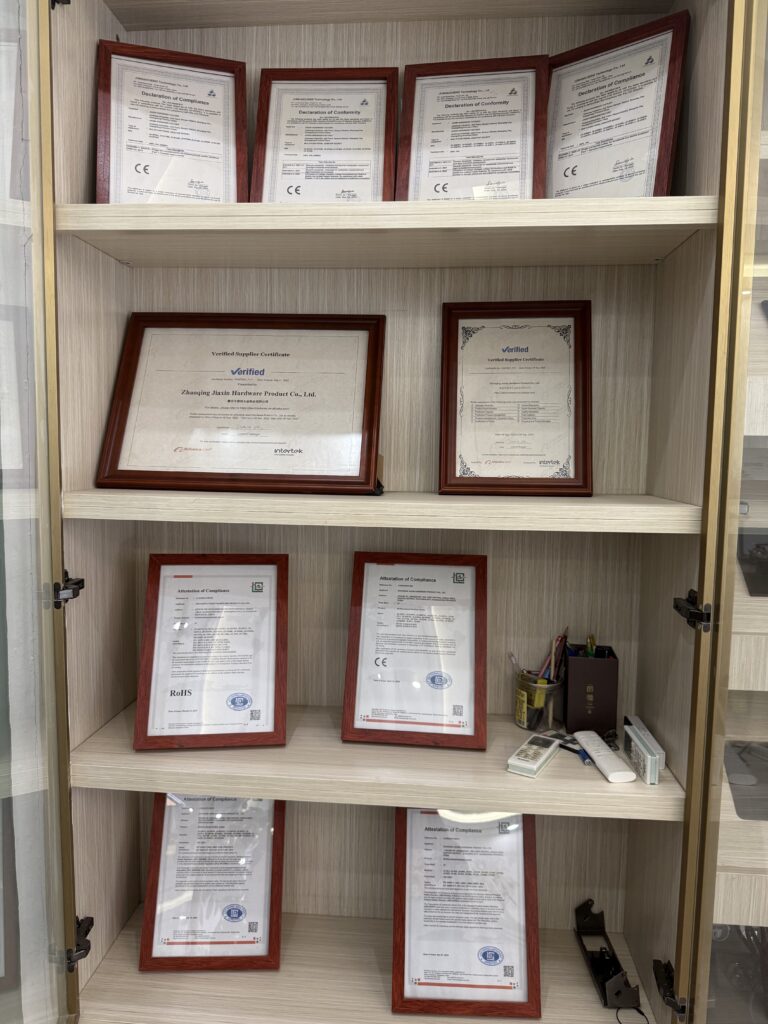
For any furniture manufacturer or importer selling into the EU, using non-certified electronic components is a serious risk. It can result in product recalls, legal liability, and lasting brand damage — especially as European market surveillance authorities have become more active in recent years.
What to verify before ordering:
- Valid CE certificate (Low Voltage Directive + EMC Directive for powered accessories)
- RoHS compliance documentation
- UKCA certification if selling into the UK market
- Laboratory test reports — not just certificate images. Ask for the actual test reports showing fire resistance, lifecycle testing, and electrical safety parameters.
At Moonian, all integrated socket solutions carry CE and RoHS certification. We provide complete test documentation to customers on request. When evaluating any pop-up desktop socket manufacturer, always insist on seeing the actual lab reports, not just a compliance badge on a catalog page.
For a detailed checklist on evaluating supplier certifications and quality systems, see our 5-factor supplier selection guide.
2. Space-Saving Architecture: The Ultra-Slim Profile
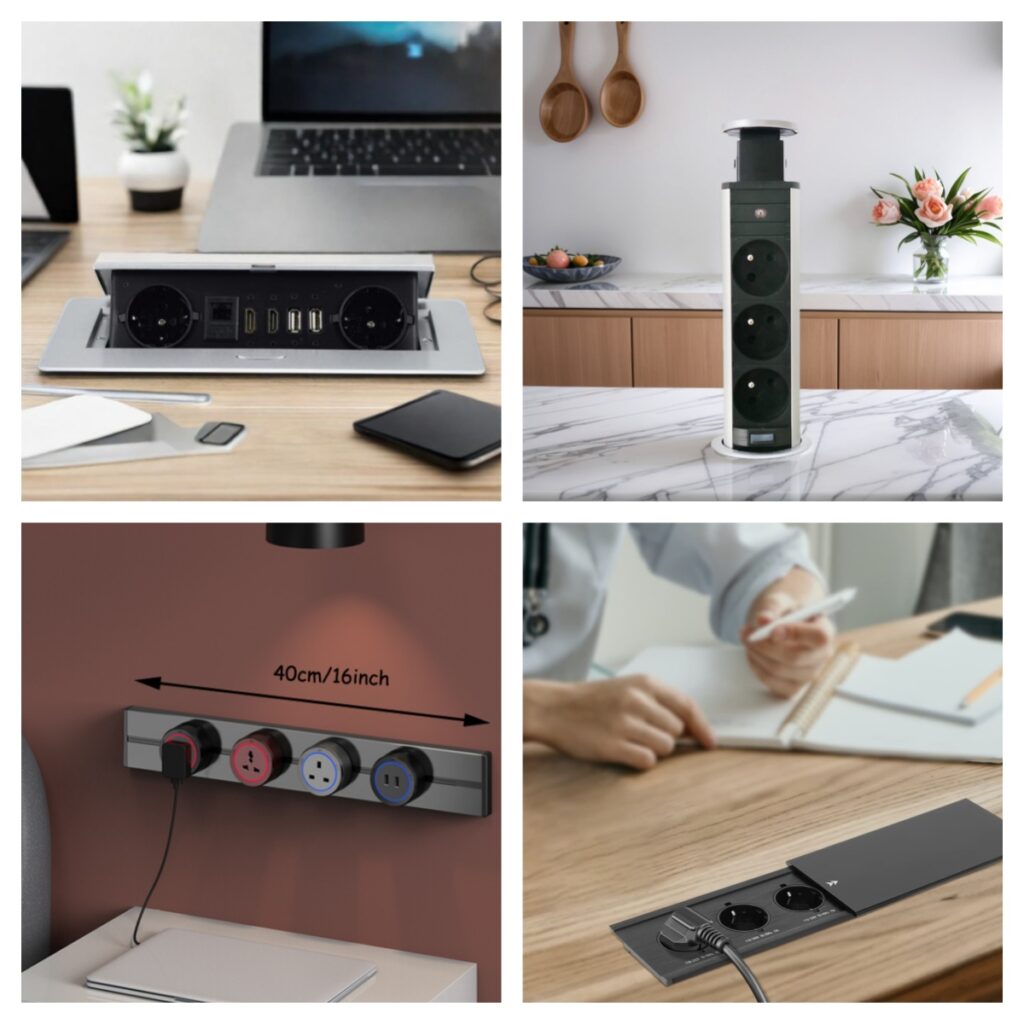
One of the most common pain points for furniture designers integrating sockets is the conflict between socket depth and available space inside the desk — particularly in designs with thin tabletops, integrated drawer systems, or cable management channels running below the surface.
Modern office furniture trends favor minimalistic, thin profiles. A socket that requires 80mm of installation depth is simply incompatible with a 30mm tabletop with a drawer immediately below.
What to look for:
- Installation depth of 60mm or less for standard models
- Ultra-slim motor and casing on electric pop-up models
- Compatibility with tabletop thicknesses from 18mm to 50mm
- Clear technical drawings showing cutout dimensions and installation clearances
Moonian’s latest generation of pull pop-up sockets is engineered with an ultra-slim profile, providing 3–5 power outlets plus high-speed USB-C charging while requiring significantly less installation depth than conventional models. We provide 3D CAD/BIM files for all models — contact our engineering team to request drawings for your specific tabletop thickness.
3. Matching the Socket Type to Your Furniture Collection
Different furniture collections and end-use environments require different socket interaction styles. Using the wrong type can frustrate end users and reflect poorly on your product.
For executive desks and premium workstations: A sliding cover socket offers a completely flush look. When closed, the cover protects outlets from dust and spills while maintaining a clean, uninterrupted desk surface — ideal for executive environments where aesthetics are paramount.
For co-working spaces and conference rooms: A pop-up socket or pull pop-up socket is preferred for ease of access and the premium feel of the activation mechanism. The rising motion communicates quality and technology to clients during meetings.
For large conference tables and collaborative workbenches: A power track socket provides maximum flexibility — outlets can be positioned and repositioned anywhere along the rail to accommodate different seating arrangements and device setups.
For kitchen islands and lab workbenches: An IP54-rated pop-up socket with splash protection is the correct specification. Standard office-grade sockets are not rated for moisture exposure.
For a full comparison of all socket types and their specifications, see our desktop socket types and features guide.
4. Material Quality: Why European Brands Choose Aluminum Alloy
The material of a socket’s panel and housing communicates quality at the moment of touch — before the user has even activated it. This matters significantly in premium furniture.
Anodized aluminum alloy is the material of choice for high-end European furniture brands for several reasons:
- The cold-touch surface feel matches metal-frame desks and premium hardware
- Hard anodizing creates a scratch-resistant surface that maintains appearance over years of daily use
- Thermal management is superior to plastic — important for high-power USB-C charging
- Available in finishes that match popular desk hardware: silver, space gray, champagne gold, and matte black
Zinc alloy is a viable mid-range option with good weight and feel, but lower scratch resistance than aluminum.
Polycarbonate (plastic) is acceptable for budget product lines but is immediately noticeable by touch compared to metal options. Top-tier European brands consistently specify aluminum alloy.
For a detailed material comparison with technical specifications, see our article on aluminum vs zinc alloy in pop-up sockets.
5. OEM Customization: Building Your Brand Into the Product
For furniture manufacturers selling under their own brand, standard catalog sockets represent a missed opportunity. A socket that carries your brand’s finish, logo, and port configuration is a product detail that premium buyers notice and remember.
What OEM customization typically covers:
- Custom finish colors matched to RAL or Pantone specifications
- Logo laser engraving or silk-screen printing on the panel
- Custom port configurations (e.g., EU + UK + USB-C + wireless charging in a single unit)
- Custom cutout dimensions for proprietary installation systems
Moonian offers OEM and ODM services from competitive minimum order quantities. Our in-house R&D team handles custom requirements with typical sample lead times of 15–20 working days. For more on what OEM customization involves, see our customization guide for furniture manufacturers.
Conclusion: Future-Proof Your Furniture Collection
The demand for smart, integrated workspace furniture is growing steadily across Europe — driven by hybrid work adoption, premium office fit-out trends, and rising expectations from corporate buyers. Integrating professional power modules is the fastest way to move a furniture collection from “standard” to “premium” positioning.
The four factors above — compliance, slim profile engineering, correct product type selection, and material quality — are the foundation. Get these right, and the socket becomes a feature that sells the desk, not a component that creates problems.
Ready to specify integrated sockets for your next collection? → Browse our full socket range → Request 3D CAD/BIM files and samples → See our CE and RoHS certified pop-up sockets