Aluminum vs. Zinc Alloy in Pop-Up Sockets: A Material Guide for Furniture Professionals

When specifying pop-up sockets for furniture integration, the panel material is one of the most consequential decisions you will make — yet it is often treated as an afterthought. The material affects not just how the socket looks and feels, but how it performs thermally, how long it lasts, and how well it matches your furniture’s hardware.
This guide compares the two most common materials — aluminum alloy and zinc alloy — across six key dimensions to help you make an informed specification decision.
For context on socket types and mechanisms, see our desktop socket types and features guide.
Why Material Choice Matters More Than You Think
The socket panel is one of the few hardware elements that sits directly on the desk surface, in the user’s line of sight and within reach. At the moment of activation, it is also the component that communicates quality through touch.
A panel that feels light, scratches easily, or looks visually mismatched against premium desk hardware will undermine the perceived quality of the entire piece — regardless of how good the mechanism is underneath.
Aluminum and zinc alloy each have genuine strengths. The right choice depends on your application, target market, and design language.
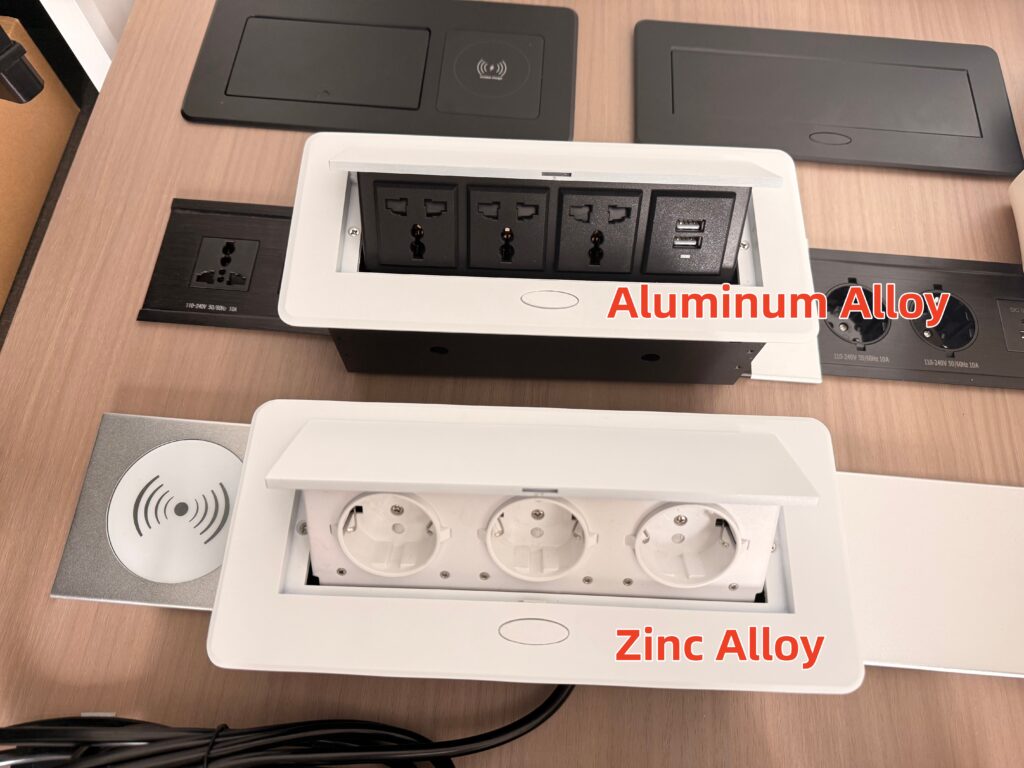
Side-by-Side Comparison
| Property | Aluminum Alloy | Zinc Alloy |
|---|---|---|
| Weight | Lighter | Heavier, more substantial feel |
| Scratch resistance | Excellent (anodized) | Good (plated) |
| Thermal conductivity | Superior — better heat dissipation | Moderate |
| Corrosion resistance | Excellent (natural oxide layer) | Good with plating |
| Surface finishing | Anodizing — durable, color-fast | Electroplating, powder coating |
| Complex casting | Limited | Excellent — sharper detail |
| Cost | Slightly higher per unit | More economical at high volume |
| Sustainability | Highly recyclable | Recyclable but heavier mining footprint |
| Best for | Modern, minimalist, premium | Ornate, traditional, high-volume |
Aluminum Alloy: The Premium Choice for Modern Furniture
Aluminum is the material of choice for most premium European office furniture brands, and for good reason.
Thermal performance is superior. USB-C Power Delivery at 65-100W generates significant heat. Aluminum’s thermal conductivity (approximately 160 W/m·K) dissipates this heat far more effectively than zinc alloy (approximately 110 W/m·K), reducing the risk of thermal throttling and extending the life of the internal electronics.
Anodizing creates a uniquely durable surface. The anodizing process converts the aluminum surface into aluminum oxide — harder than the base metal, deeply bonded, and resistant to scratching and corrosion. Color anodizing produces finishes that remain stable over years of daily use. This is why anodized aluminum is specified for aerospace components, premium consumer electronics, and architectural hardware.
The cold-touch feel communicates premium quality. At the moment of activation, aluminum feels noticeably different from zinc alloy or plastic — cooler, smoother, more precise. In executive furniture, this tactile quality is part of the product proposition.
Best applications for aluminum:
- Executive desks and high-end office furniture
- Hotel room and hospitality furniture
- Residential furniture in premium market segments
- Any application where the socket will be visible and touched frequently
Zinc Alloy: The Practical Choice for Complex Designs and Volume
Zinc alloy should not be dismissed as a budget option — it has genuine technical advantages in specific applications.
Die-casting enables sharper detail and complex forms. Zinc alloy flows into molds with greater precision than aluminum, making it the correct choice when the socket design includes intricate shapes, fine edges, or detailed surface patterns. If your furniture collection uses ornate hardware with complex profiles, zinc alloy will produce a closer aesthetic match.
Higher density creates a substantial feel. Zinc alloy is approximately 2.5x denser than aluminum. For some buyers and markets, this weight communicates solidity and quality — particularly in traditional or classic furniture styles where the modern lightness of aluminum may feel out of place.
More economical for large volumes. At high production quantities, zinc alloy die-casting is typically more cost-effective than aluminum CNC machining or extrusion. For furniture manufacturers producing at scale with competitive pricing requirements, this cost difference can be meaningful.
Best applications for zinc alloy:
- Traditional and classic furniture styles with ornate hardware
- Educational and healthcare environments requiring impact resistance
- High-volume production where cost efficiency is a priority
- Applications where complex panel geometry is required
What About Plastic?
Polycarbonate (PC) panels are used in budget-tier sockets. For premium furniture applications, plastic is generally not appropriate:
- Scratch and abrasion resistance is significantly lower than metal
- Thermal performance is the weakest of the three options
- The tactile quality communicates budget hardware regardless of furniture quality
- Color consistency is harder to maintain over the product lifecycle
The exception is the internal housing structure, where flame-retardant PC is the correct and safe specification for all socket types regardless of panel material.
Making the Right Choice for Your Project
Choose aluminum when:
- Your furniture targets the premium or executive segment
- The design language is modern or minimalist
- Thermal management is a priority (high-power USB-C charging)
- Corrosion resistance matters (kitchen, hospitality, outdoor-adjacent applications)
- Color consistency and long-term surface quality are important
Choose zinc alloy when:
- Your design requires complex or ornate panel geometry
- You are producing at high volume with competitive pricing requirements
- The furniture style is traditional or classic
- A heavier, more substantial feel is preferred by your target market
Consider offering both when:
- You have premium and standard tiers in the same product line
- Different markets in your export portfolio have different preferences
Moonian’s Material Range
Moonian manufactures pop-up sockets in both anodized aluminum alloy and zinc alloy across our product range. Both material options are available with CE and RoHS certification, and both can be customized for finish color and branding through our OEM service.
For applications requiring the highest thermal performance — particularly sockets with 100W USB-C Power Delivery — our engineering team recommends aluminum alloy panels. For more on USB-C PD specifications, see our USB-C Power Delivery guide.
For guidance on choosing between socket types (pop-up, pull pop-up, sliding, track), see our desktop socket types guide.
Ready to specify the right material for your next project? → Browse our pop-up socket range → View sliding cover socket options → Request samples in both materials