
Power Track Socket Systems: The Complete Guide for Furniture Manufacturers

Of all the integrated power solutions available for furniture, the power track socket is the most flexible. Where a pop-up socket has a fixed location, a track system allows outlets to be positioned — and repositioned — anywhere along a rail. For furniture serving dynamic, multi-user environments, this adaptability is a genuine competitive advantage.
This guide explains how power track systems work, where they outperform fixed sockets, and what to look for when specifying them for your furniture line.
For an overview of all socket types including pop-up and sliding options, see our desktop socket types and features guide.
How Power Track Systems Work
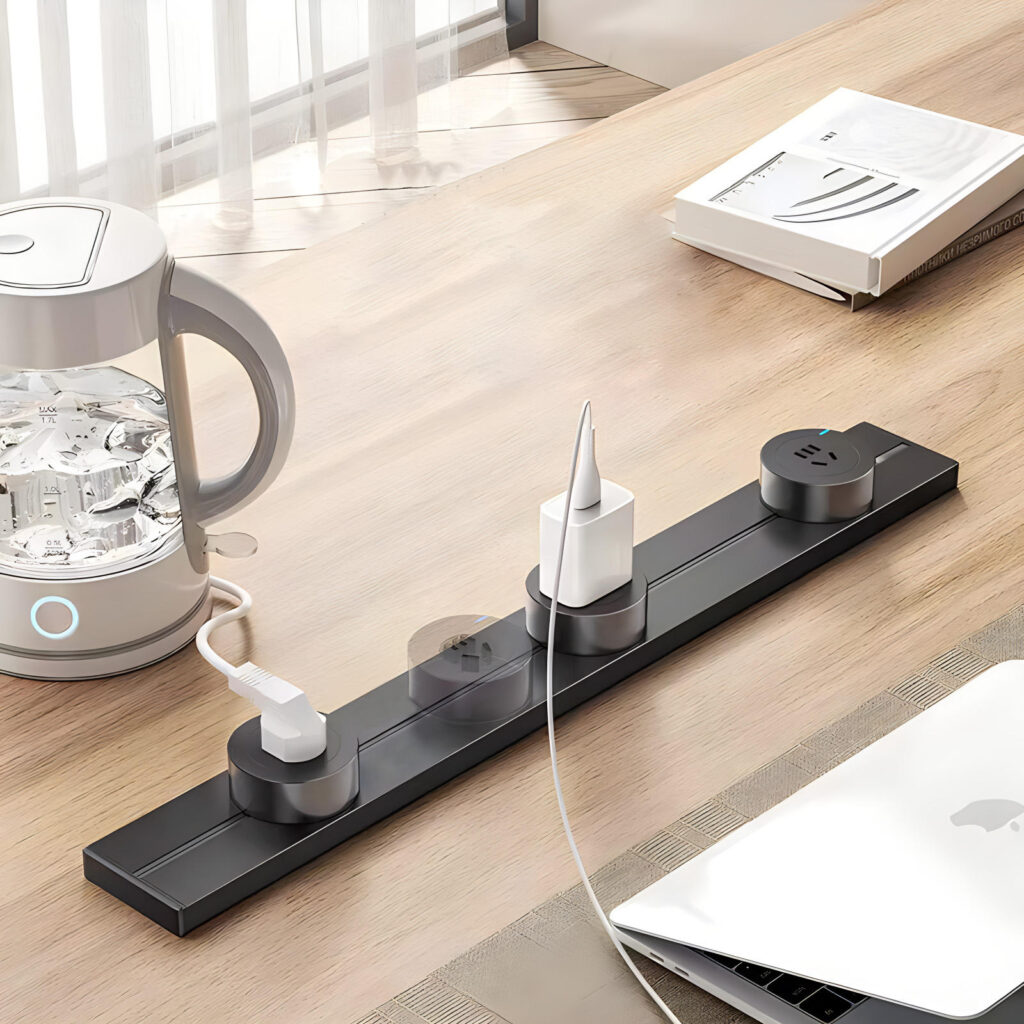
A power track socket consists of two components: a fixed rail that is installed into the furniture surface or edge, and modular socket units that attach to the rail and can slide to any position along it.
The rail carries the electrical supply internally. Socket modules are inserted by a simple click mechanism and lock securely in position — they can be moved or removed at any time without tools. This means the power configuration of a desk or table can be changed as user needs evolve, without any reinstallation work.
Track systems are available in standard lengths (typically 300mm to 1200mm) and can often be cut to custom lengths, making them suitable for a wide range of furniture dimensions.
Key Advantages Over Fixed Sockets
Unlimited positioning flexibility. The most important advantage. A conference table whose seating arrangement changes weekly benefits enormously from outlets that can move with the users, rather than fixed sockets that some attendees cannot reach.
Expandable capacity. Additional socket modules can be added to an existing rail at any time. A desk specified with two outlets today can have four tomorrow, without any structural modification.
Cleaner cable management. Because outlets can be positioned directly adjacent to each device, cable runs are shorter and more manageable than with fixed sockets that may be far from the connected device.
Future-proof. As device charging standards change (USB-C replacing USB-A, higher wattage requirements), individual track modules can be swapped out for updated versions without replacing the entire installation.
Best Applications for Power Track Systems
Conference and meeting tables. The primary application. Long conference tables benefit from multiple track modules distributed across the table length, allowing every attendee easy access to power regardless of seating position.
Collaborative workbenches. In design studios, makerspaces, and educational workshops, equipment configurations change frequently. Track systems accommodate this without fixed infrastructure constraints.
Kitchen islands. A track mounted along the side of an island allows appliances — blenders, coffee machines, food processors — to be plugged in exactly where they are being used, then moved out of the way.
Standing desks and height-adjustable furniture. Cable management is a particular challenge with adjustable-height furniture. A track mounted on the desk surface (rather than routed through the frame) simplifies this considerably.
Reception desks and front-of-house furniture. Reception areas often need to charge visitor devices while maintaining a clean, professional surface. A track along the inner edge of a reception desk provides discreet, flexible access.
Technical Specifications to Check
When evaluating power track products, confirm the following:
- Total load capacity: Typically 2500W-3680W per rail. Ensure this covers the expected connected devices.
- Module interface options: Confirm available combinations — AC outlets (EU/UK/US), USB-C PD, USB-A, and data ports (Ethernet, HDMI) where required.
- Installation method: Surface-mounted or recessed. Recessed gives a cleaner appearance but requires planning during furniture construction.
- Safety certification: CE and RoHS for EU/UK markets. Child safety shutters on all AC outlets.
- IP rating: For kitchen and outdoor-adjacent applications, IP54 minimum.
- Rail material and finish: Should complement the furniture’s material palette. Aluminum alloy rails with anodized finish are recommended for premium applications.
For more on safety certifications and what to require from suppliers, see our 5-factor supplier evaluation guide.
Power Track vs. Fixed Pop-Up: How to Choose
| Scenario | Better Choice |
|---|---|
| Fixed workstation, single user | Pop-up socket |
| Conference table, changing seating | Power track |
| Executive desk, premium aesthetics | Pop-up or sliding cover |
| Long collaborative bench | Power track |
| Kitchen island | Pop-up (IP54) or track |
| Small desk, thin tabletop | Sliding cover socket |
The two solutions can also be combined: a fixed pop-up socket for the primary user position, plus a short track for peripheral or guest access along the table edge.
Moonian’s Power Track Range
Moonian manufactures power track socket systems alongside our pop-up and sliding socket lines, allowing furniture manufacturers to specify a consistent supplier for all integrated power components across a product line.
Our track systems are CE and RoHS certified, available with customizable rail lengths, and compatible with our standard OEM finish options for color and branding consistency.
Ready to specify power tracks for your next project? → Browse our power track socket range → View pop-up socket options for comparison → Request samples and technical drawings