
How to Import Pop-Up Sockets from China to Europe: A Practical Guide for Furniture Manufacturers

China is the world’s dominant manufacturer of integrated desktop power components. If you are a furniture manufacturer or wholesaler in Europe sourcing pop-up sockets, sliding cover sockets, or power track systems, the supply chain almost certainly runs through Guangdong Province — whether you are buying directly from a factory or through a European distributor who is doing the same.
Buying directly from a Chinese manufacturer eliminates the distributor margin and gives you access to OEM customization, factory pricing, and a direct relationship with the people who make the product. But it also means taking responsibility for the import process — certifications, customs classification, duties, and logistics — that a distributor would otherwise handle.
This guide walks you through the complete import process, step by step, so you know exactly what to prepare, what to watch out for, and how to avoid the mistakes that cost time and money.
Step 1: Verify Your Supplier Is a Manufacturer, Not a Trading Company
Before anything else — before discussing certification, pricing, or logistics — confirm that you are dealing with a factory, not a trading company presenting itself as one.
This matters for the import process specifically because trading companies often cannot provide the factory-level documentation that customs authorities and market surveillance bodies may request. A product-specific CE certificate, a factory audit report, or a batch-traceable quality record requires a factory to produce. A trading company that sources from multiple factories cannot reliably supply these.
For a full guide on how to verify whether a supplier is a genuine manufacturer, see our article on 5 questions to ask before placing your first order.
Step 2: Confirm CE and RoHS Certification Before Any Shipment
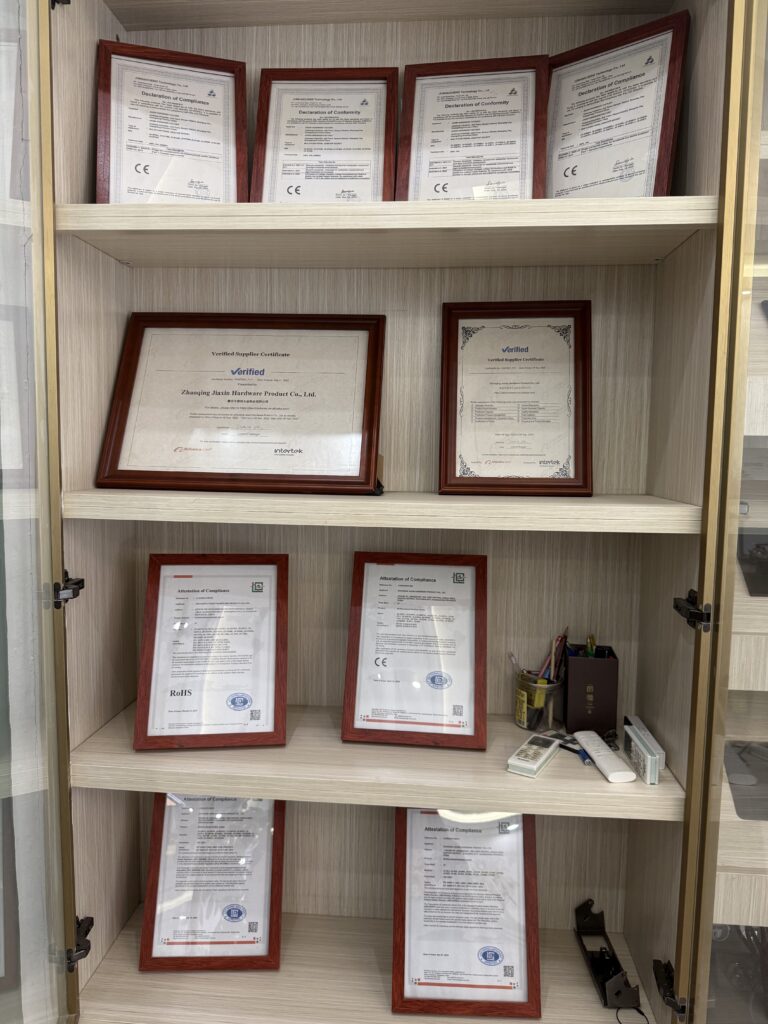
This is the single most important compliance step for importing electrical components into the EU. Pop-up sockets and integrated power units are electrical products subject to the Low Voltage Directive (LVD) and the EMC Directive, both of which require CE marking before the product can be placed on the EU market.
What CE marking requires:
- A Declaration of Conformity (DoC) issued by the manufacturer
- Test reports from an accredited third-party laboratory confirming the product meets the relevant harmonized standards
- CE marking physically applied to the product or its packaging
- A technical file maintained by the manufacturer
What to request from your supplier before shipment:
- The full Declaration of Conformity — not just a CE logo image
- The laboratory test reports behind the DoC, confirming the specific product model tested
- RoHS compliance documentation listing restricted substances
- UKCA documentation if any of your products will be sold into the UK market
The critical detail: the test reports must name the specific product model you are importing. Generic company-level CE certificates that do not identify the product are not sufficient for EU market compliance and will not satisfy customs or market surveillance requests.
A supplier who cannot or will not provide product-specific test reports is a supplier whose certification may not hold up — and the consequences of non-compliant electrical components entering the EU land on the importer, not the Chinese manufacturer.
For more on what certification documentation to request and how to evaluate it, see our supplier evaluation checklist.
Step 3: Classify Your Products with the Correct HS Code
Every product crossing an international border requires a Harmonized System (HS) code — the internationally standardized numerical classification that determines customs duties, import regulations, and statistical reporting.
For pop-up sockets and integrated desktop power units, the relevant HS codes fall within Chapter 85 (Electrical machinery and equipment). The specific subheading depends on the product configuration:
Commonly used HS codes for desktop power units:
- 8536.41 — Relays for a voltage not exceeding 1,000V (applicable to some socket types)
- 8536.61 — Lamp-holders, plugs and sockets (the most commonly applicable heading for standard pop-up sockets)
- 8536.69 — Other plugs and sockets (for combination units with USB charging)
- 8504.40 — Static converters (may apply to units with USB-C PD charging modules)
Important: HS code classification is a legal determination. The codes above are a starting point — your customs broker or freight forwarder should confirm the correct classification for your specific products before import. Misclassification can result in incorrect duty payments, customs delays, or penalties.
EU import duties: Under the EU’s Common Customs Tariff, electrical socket products from China typically attract duties in the range of 2.7% to 3.7% depending on the specific classification. Your freight forwarder can confirm the current applicable rate for your product.
Step 4: Choose the Right Shipping Method
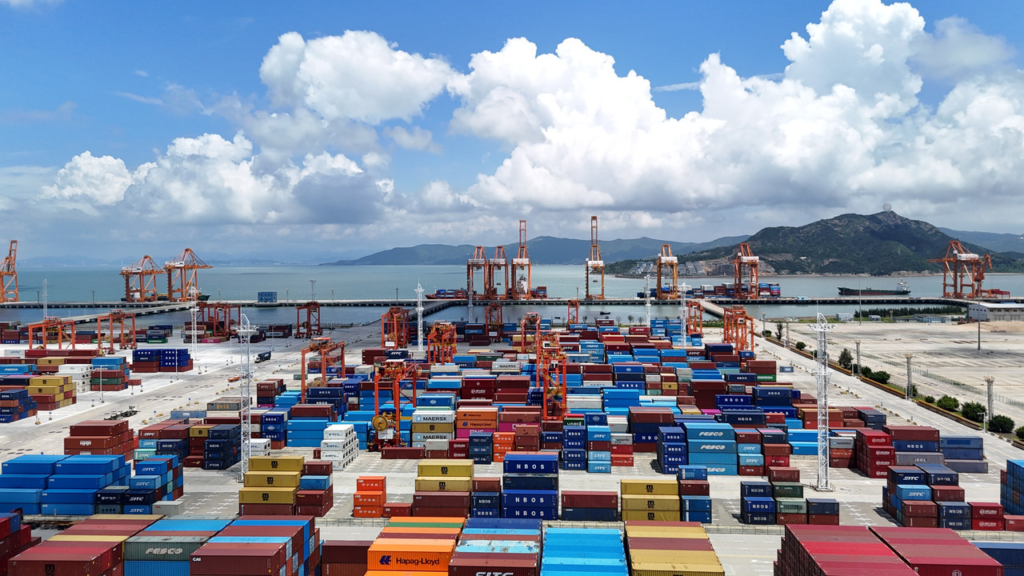
The choice between sea freight, air freight, and express courier depends on your order volume, timeline, and cost tolerance.
Sea freight (FCL or LCL):
Sea freight is the standard choice for volume orders — typically anything above 200kg or 1 CBM where the economics justify the longer transit time.
- Transit time from Guangdong to major European ports (Rotterdam, Hamburg, Antwerp): 25–35 days
- Cost: significantly lower per kg/CBM than air freight for volume shipments
- FCL (Full Container Load): your goods fill an entire container — lower per-unit cost, suitable for large orders
- LCL (Less than Container Load): your goods share a container with other shipments — higher per-unit cost but no minimum volume requirement
Air freight:
Suitable for smaller, time-sensitive shipments or for first sample orders.
- Transit time from Guangdong to major European airports: 5–8 days
- Cost: significantly higher per kg than sea freight
- Practical for shipments under 100kg where the speed premium is justified
Express courier (DHL, FedEx, UPS):
Suitable for samples, small urgent orders, and documentation.
- Transit time: 3–5 days door to door
- Cost: highest per kg, but includes door-to-door delivery and customs clearance
- Practical threshold: typically under 30kg
For first orders: many European buyers use air freight or express courier for the initial sample shipment to evaluate quality, then switch to sea freight for production orders. This adds cost to the sample stage but allows quality verification before committing to a volume sea freight order.
Step 5: Prepare Your Import Documentation
A complete import shipment requires the following documents. Your supplier provides most of these — confirm which documents they will prepare and which you need to arrange.
Supplied by the manufacturer:
- Commercial Invoice (stating product description, HS code, unit price, total value, and Incoterms)
- Packing List (itemizing boxes, weights, and dimensions)
- CE Declaration of Conformity
- Laboratory test reports (for customs or market surveillance requests)
- Bill of Lading (sea freight) or Airway Bill (air freight)
Arranged by the importer or freight forwarder:
- Import declaration (filed by your customs broker)
- Proof of origin (if claiming preferential duty rates under any applicable trade agreement)
- EORI number (Economic Operators Registration and Identification — required for all EU importers)
If you do not have an EORI number: apply through your national customs authority. In Germany, this is the Bundeszollverwaltung; in Poland, the Krajowa Administracja Skarbowa; in the Netherlands, the Belastingdienst/Douane. Processing typically takes a few working days.
Step 6: Work with a Freight Forwarder for Your First Shipment
For buyers importing from China for the first time, working with an experienced freight forwarder is strongly recommended. A freight forwarder handles:
- Booking cargo space with the shipping line or airline
- Preparing and filing export documentation on the China side
- Arranging customs clearance at the European port of entry
- Managing delivery to your warehouse or production facility
- Advising on HS code classification and applicable duties
The cost of a freight forwarder is modest relative to the risk of a first shipment going wrong due to documentation errors, incorrect classification, or customs holds. For subsequent shipments once the process is established, many buyers handle logistics directly.
What to tell your freight forwarder:
- Product description and HS code (your supplier can provide a suggested code)
- Shipment volume (weight and CBM)
- Port of origin (typically Guangdong — Guangzhou Nansha or Yantian/Shekou for Shenzhen)
- Destination port or address
- Incoterms agreed with your supplier (EXW, FOB, or CIF — see below)
Understanding Incoterms: EXW, FOB, and CIF
Incoterms define where the supplier’s responsibility ends and the buyer’s begins. Most Chinese manufacturers quote EXW (Ex Works) as their standard term, but FOB is often more practical for European buyers.
EXW (Ex Works): The supplier’s responsibility ends at the factory gate. You arrange and pay for all transport — inland trucking to the port, export customs clearance, sea/air freight, import customs, and final delivery. Lowest quoted price, but you bear all logistics risk and cost.
FOB (Free on Board): The supplier delivers the goods to the named port and clears them for export. You arrange and pay for sea/air freight from the Chinese port, import customs, and delivery. The most common term for European buyers importing from China — it splits responsibility cleanly at the ship’s rail.
CIF (Cost, Insurance, Freight): The supplier arranges and pays for freight and insurance to the named European port. You handle import customs and delivery from the port. Convenient but typically more expensive than arranging your own freight — suppliers mark up the logistics cost.
Recommendation for most European buyers: negotiate FOB from the nearest major port to the factory (Guangzhou Nansha for Guangdong-based suppliers) and arrange your own freight forwarder from that point. This gives you control over the logistics chain and typically produces better pricing than CIF.
Common Mistakes That Delay or Complicate the Import
Accepting generic CE certificates. The most common compliance mistake. Always request product-specific test reports before shipment, not after.
Incorrect HS code classification. Using the wrong HS code can result in incorrect duty payments or customs holds. Confirm with your freight forwarder before the first shipment.
No EORI number. Many first-time importers discover they need an EORI number only when the shipment arrives. Apply well in advance — processing time varies by country.
Undervaluing goods on the commercial invoice. Declaring a lower value than the actual transaction price to reduce customs duties is illegal and carries serious penalties. Always declare the true transaction value.
Not accounting for lead time in full. The total timeline from order confirmation to goods received in your warehouse is typically 8–12 weeks for a sea freight order: 25–35 days production + 25–35 days sea transit + 3–7 days customs clearance and delivery. Plan your inventory accordingly.
Skipping the sample stage. Importing a full production order from a new supplier without evaluating samples first is a significant risk. The cost of an air freight sample shipment is small relative to the cost of a non-conforming production order.
A Complete Import Timeline for First-Time Buyers
| Stage | Typical Duration |
|---|---|
| Supplier evaluation and sample request | 1–2 weeks |
| Sample production | 15–20 working days |
| Sample shipment (air/express) | 3–8 days |
| Sample evaluation and approval | 1–2 weeks |
| Production order placed, deposit paid | Day 0 |
| Production | 25–35 working days |
| Export customs and port handling | 3–5 days |
| Sea freight transit to Europe | 25–35 days |
| Import customs clearance | 3–7 days |
| Delivery to warehouse | 1–3 days |
| Total from order to warehouse | 10–14 weeks |
Plan your first import with this timeline in mind. Subsequent orders from the same supplier — where samples are already approved and the logistics process is established — can be compressed to 8–10 weeks.
How Moonian Supports European Importers
Moonian has supplied European furniture manufacturers and wholesalers since 2018. We understand the documentation, certification, and logistics requirements of European buyers and structure our export process accordingly.
What we provide as standard:
- Product-specific CE and RoHS Declarations of Conformity
- Full laboratory test reports traceable to product model and batch
- Commercial Invoice and Packing List in the format required by European customs
- Suggested HS codes for our products
- FOB quotations from Guangzhou Nansha port
- Proactive communication on production progress and shipment tracking
For buyers making their first import from China, our team is available to answer documentation questions and coordinate with your freight forwarder to ensure a smooth first shipment.
For more on evaluating Moonian as a supplier before placing your first order, see our 5 questions to ask before your first order and our guide on why European furniture brands choose Moonian.
Ready to start your first import? → Request a quotation and sample → Browse our CE certified product range → Read our supplier evaluation checklist → See our direct factory vs traders cost analysis