5 Questions to Ask Before Placing Your First Order with a Chinese Socket Manufacturer

Sourcing pop-up sockets and integrated power components from China offers genuine advantages: competitive pricing, manufacturing expertise, and access to a product range that is far wider than what European or Middle Eastern domestic suppliers can offer. But first orders carry real risk — and the furniture manufacturers and wholesalers who get burned are almost always those who did not ask the right questions before committing.
This guide gives you five specific questions to ask any Chinese socket manufacturer before placing your first order. Each question is designed to reveal something important about the supplier — and the answers will tell you far more than a polished website or a well-presented catalogue ever will.
Question 1: Are You the Manufacturer, or Are You a Trading Company?
This is the first question to ask, and the answer determines almost everything else.
Trading companies present themselves as manufacturers constantly. They use factory-adjacent language, show production photos that may belong to third-party factories, and provide product catalogues that look identical to a factory’s. The distinction matters enormously in practice.
What a trading company cannot give you:
- Direct access to the engineers who designed and make the product
- Accountability when something goes wrong in production
- Genuine customization capability — they relay your requirements to a factory they may not have a fixed relationship with
- Consistent quality across batches, because they may source from different factories depending on capacity and price
- Factory-level pricing — their margin sits on top of the factory price you could be paying directly
How to verify the answer:
Ask for the factory’s business license (营业执照) and check whether the registered business scope includes manufacturing (制造 or 生产). Ask for the factory address and cross-reference it on Google Maps or Baidu Maps — a legitimate factory will appear as an industrial facility, not an office building.
Ask to arrange a video call from the production floor. A trading company will struggle to produce this convincingly. A factory will not.
At Moonian, our production facility is in Jinli Town, Gaoyao District, Zhaoqing, Guangdong. We manufacture all products in-house across 30 production lines with over 100 employees. We welcome video factory tours at any stage of the evaluation process.
For a detailed analysis of the cost difference between factory-direct and trader sourcing, see our direct factory vs traders total cost analysis.
Question 2: Can You Show Me the Actual Test Reports — Not Just the Certificate?
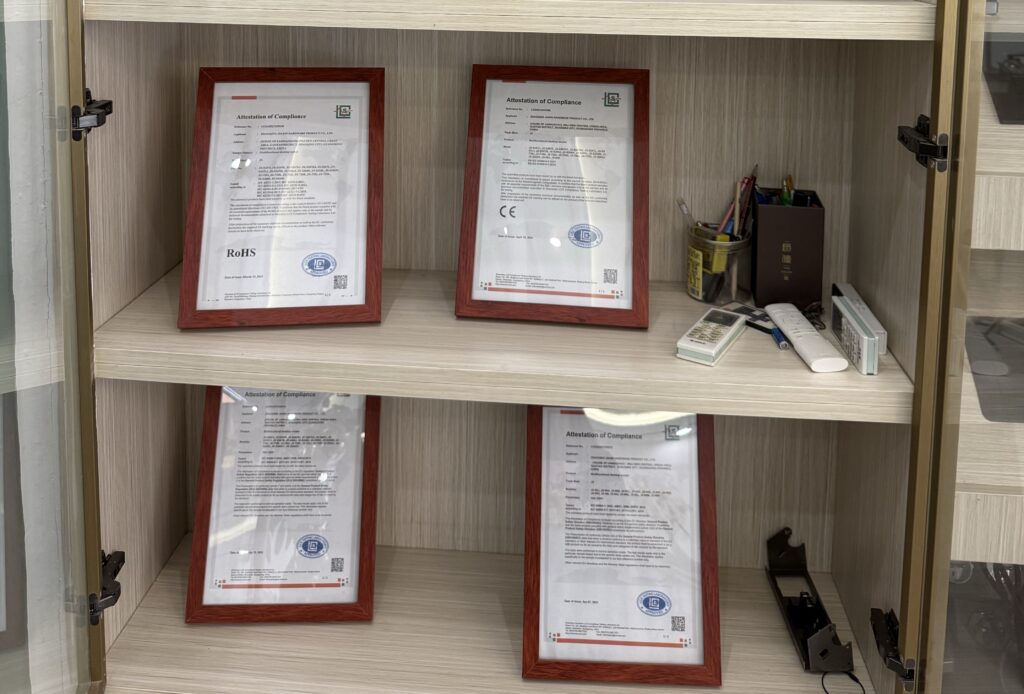
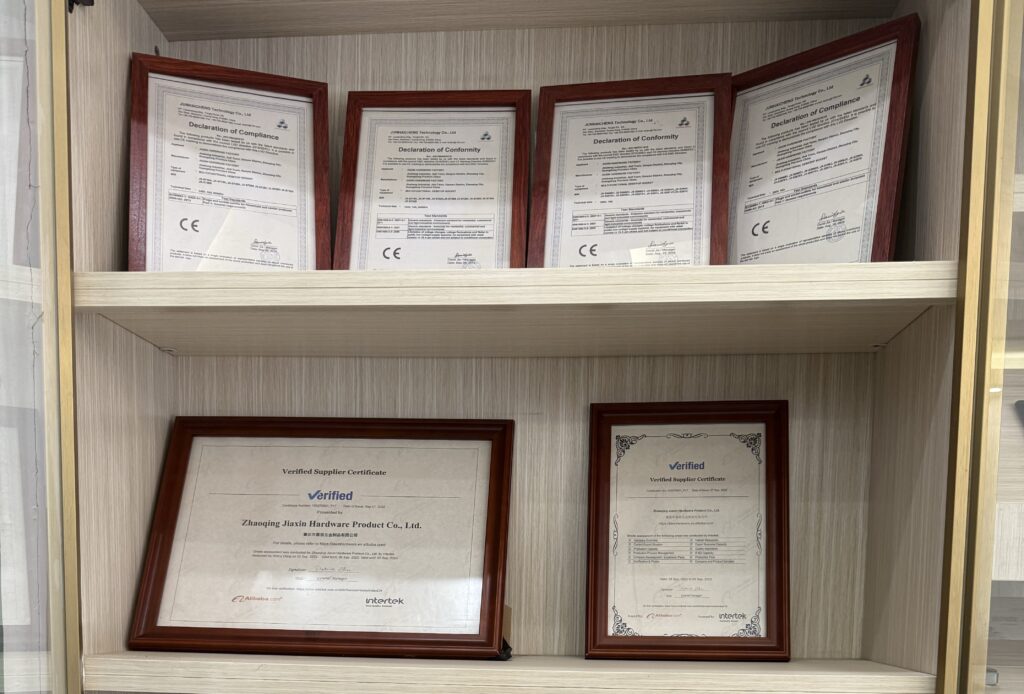
CE and RoHS certification is the minimum requirement for any electrical component sold into the European market. But certificates alone are not sufficient verification. A certificate image is easy to reproduce, alter, or present out of context. The test report behind the certificate is what tells you whether the certification is real and applicable to the product you are buying.
What to ask for specifically:
- The full laboratory test report, not just the certificate page
- Confirmation that the test report names the specific product model you are purchasing — not a generic company-level certification
- The name of the testing laboratory — it should be an accredited third-party lab, not an internal document
- UKCA documentation if you are selling into the UK market
- RoHS compliance documentation listing the specific restricted substances tested
What the answers reveal:
A supplier who provides complete, product-specific test reports from accredited laboratories is a supplier who has genuinely invested in compliance. A supplier who sends a certificate image and becomes evasive when asked for the underlying reports is a supplier whose certification may not hold up when your shipment reaches customs in Rotterdam or Hamburg.
The consequence of getting this wrong:
Non-compliant components in furniture sold into the EU create customs delays, potential product recalls, and liability exposure. The cost of a compliance failure is not the price of the components — it is the cost of a recalled product line and the reputational damage that follows.
Moonian provides full test documentation — including laboratory test reports traceable to specific product models — at the inquiry stage, before any order is placed. For guidance on what documentation to request, see our supplier evaluation checklist.
Question 3: What Is Your Minimum Order Quantity, and Is It the Same for Custom Specifications?
MOQ is one of the most misunderstood aspects of sourcing from Chinese manufacturers. The quoted MOQ for standard catalog products is often very different from the MOQ for customized specifications — and the gap between the two can make or break the economics of a custom product line.
What to ask specifically:
- What is the MOQ for standard catalog products?
- What is the MOQ for custom finish colors or logo engraving?
- What is the MOQ for a fully custom port configuration?
- Does new tooling add cost, and if so, is it a one-time charge or per-order?
- Can sample fees be offset against the first production order?
What the answers reveal:
A supplier with transparent, consistent MOQ structures across standard and custom products is a supplier whose pricing you can plan around. A supplier who quotes a low standard MOQ but then inflates the MOQ for any customization — or adds large tooling fees that were not mentioned upfront — is signaling that the quoted price is not the actual price.
For furniture brands who want custom finishes, mixed port configurations, or logo integration, the effective MOQ for their actual product requirement may be significantly higher than the headline figure. Clarifying this before the first order avoids a situation where the economics of a custom product line only become apparent after significant development investment.
At Moonian, we provide clear MOQ structures for both standard and OEM products at the inquiry stage. For more on what our OEM process involves, see our OEM customization guide.
Question 4: What Does Your Quality Control Process Look Like?
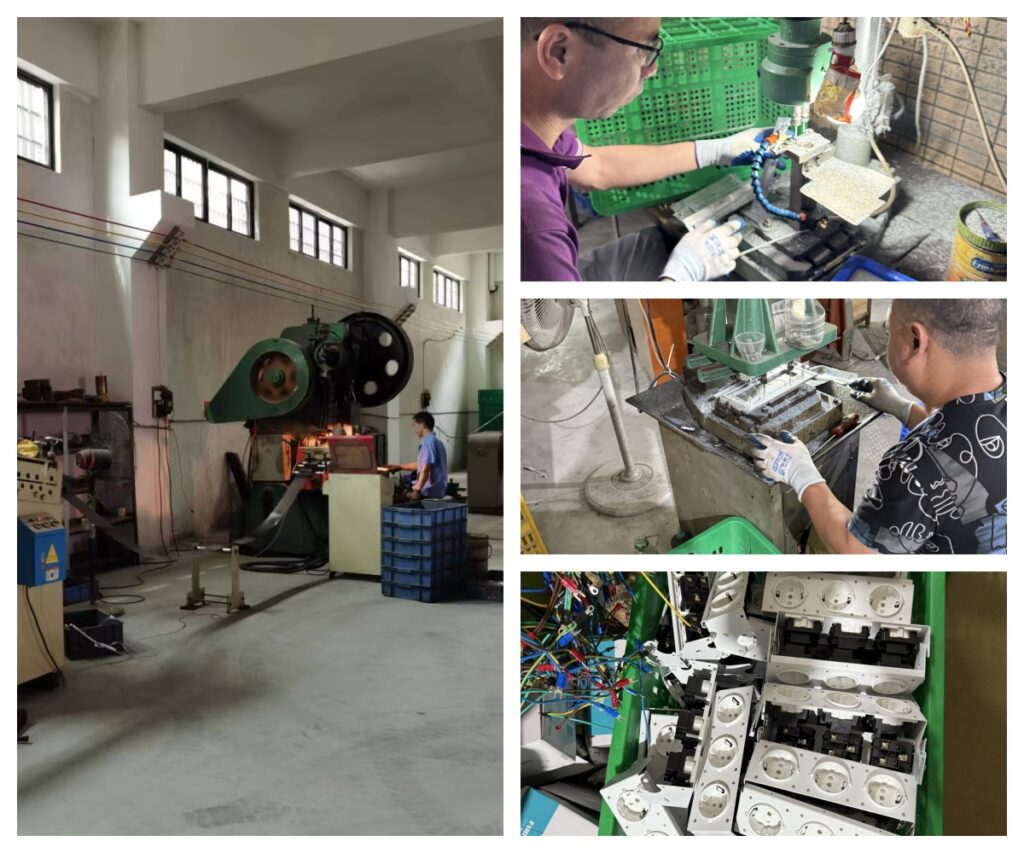
Every supplier will tell you their quality is excellent. The question is not whether they claim good quality — it is what specific process they use to ensure it, and how that process is documented.
What to ask specifically:
- Do you perform 100% inspection or sampling-based QC?
- What is your defect rate on outgoing shipments?
- What happens if defective units are found after delivery — what is the claims process?
- Can you provide the QC records for a recent production batch?
- What cycle life testing do you perform on your mechanisms?
What the answers reveal:
The distinction between 100% inspection and sampling-based QC is significant for electrical components. At a 1% defect rate — which is not unusual for sampling-based manufacturing — a 5% sampling policy statistically allows defective units to reach your customers. For safety-critical components like electrical sockets integrated into furniture, this is an unacceptable risk.
A supplier who can provide documented QC records for recent batches, specify the cycle life ratings of their mechanisms, and articulate a clear claims process is a supplier who treats quality as an operational commitment rather than a marketing claim.
The cycle life question is particularly important:
Residential-grade socket mechanisms are typically rated to 10,000 cycles. Commercial-grade mechanisms run to 30,000–50,000 cycles. If you are supplying furniture for offices, hotels, co-working spaces, or educational institutions, the difference between these ratings determines whether the component will last the furniture’s expected service life or fail prematurely — generating warranty claims and damaging your relationship with the end buyer.
For more on what commercial-grade durability means in practice, see our durable sockets for commercial furniture guide. For a behind-the-scenes look at Moonian’s assembly and inspection process, see our manufacturing process article.
Question 5: What Is Your Lead Time — and What Can Delay It?
Lead time is the parameter that causes the most friction in first-order relationships between European buyers and Chinese manufacturers. A quoted lead time of 25 days can easily become 50 days if the supplier omits the sample approval stage, does not account for Chinese public holidays, or underestimates production queue time during peak periods.
What to ask specifically:
- What is the lead time from deposit payment to shipment-ready?
- Does this include sample production and approval, or does the production clock start after sample sign-off?
- What are the major Chinese public holidays that might affect my order timeline?
- What is your current production queue — are there orders ahead of mine that could affect my lead time?
- What happens if production is delayed — how do you communicate this, and what are my options?
What the answers reveal:
A supplier who gives a single lead time figure without any qualification is either oversimplifying or not accounting for the full process. The realistic timeline for a first order from a new supplier — including sample production, sample shipping, buyer review, sample approval, deposit processing, production, and shipping — is typically 6 to 10 weeks for standard products, and 10 to 14 weeks for custom specifications.
A supplier who walks you through each stage of this timeline, flags the risk periods (Chinese New Year, Golden Week, summer peak season), and commits to proactive communication if there are delays is a supplier you can plan your production schedule around.
For context on Chinese public holidays that affect lead times:
- Chinese New Year (late January to mid-February): factories typically close for 2–3 weeks, and production slows in the weeks before and after
- Golden Week (first week of October): 7-day national holiday
- Labour Day (early May): 3–5 day holiday
Any first order placed in the 4 weeks before Chinese New Year should account for significantly extended lead times.
At Moonian, our standard production lead time is 25–35 working days after sample approval and deposit. We communicate proactively if anything changes, and we flag holiday periods at the order confirmation stage.
Putting It Together: A Pre-Order Checklist
Before committing to a first order with any Chinese socket manufacturer, confirm you have answers to all five questions:
- Factory or trader? Business license sighted, factory address verified, video tour arranged or completed
- Certifications? Full laboratory test reports received, product-specific, from accredited third-party labs
- MOQ structure? Standard and custom MOQs confirmed, tooling costs clarified, sample offset policy confirmed
- Quality process? Inspection methodology confirmed (100% vs sampling), cycle life ratings confirmed, claims process documented
- Lead time? Full timeline mapped from deposit to delivery, holiday periods accounted for, communication process agreed
A supplier who answers all five questions clearly, consistently, and with supporting documentation is a supplier worth doing business with. A supplier who is evasive, inconsistent, or unable to provide documentation on any of these points is showing you exactly what the relationship will be like when something goes wrong.
How Moonian Answers These Questions
We have structured our customer onboarding process around exactly these concerns, because we know they are the questions serious European buyers need answered before they can commit.
- Factory verification: business license available, factory address on Google Maps, video tours arranged within 48 hours of request
- Certifications: full CE, RoHS, and UKCA test reports provided at inquiry stage, traceable to specific product models
- MOQ: standard and OEM MOQs provided upfront, sample fees offset against first production order
- Quality: 100% pre-shipment inspection on every unit, cycle life ratings documented per model, clear claims process
- Lead time: 25–35 working days standard production after sample approval, holiday periods flagged at order confirmation
Ready to ask us these questions? → Request certification documentation → Browse our full product range → Read our supplier evaluation checklist → See why European brands choose Moonian