
Behind the Scenes: Precision Assembly of Industrial-Grade Pop-Up Desktop Sockets
Step inside our factory floor, where engineered table outlets take shape. This exclusive footage captures the meticulous assembly of pop-up desktop sockets – from raw components to robust power solutions.

Behind the Scenes: How Moonian Assembles Pop-Up Desktop Sockets
Most buyers evaluate a pop-up socket by its finish, its feel when activated, and its certification documentation. What they rarely see is the assembly process that determines whether those qualities hold up after 30,000 activations in a commercial environment.
This article takes you inside Moonian’s production facility in Jinli Town, Gaoyao District, Guangdong Province — where our pop-up desktop sockets are assembled from individual components to finished, tested units ready for shipment.
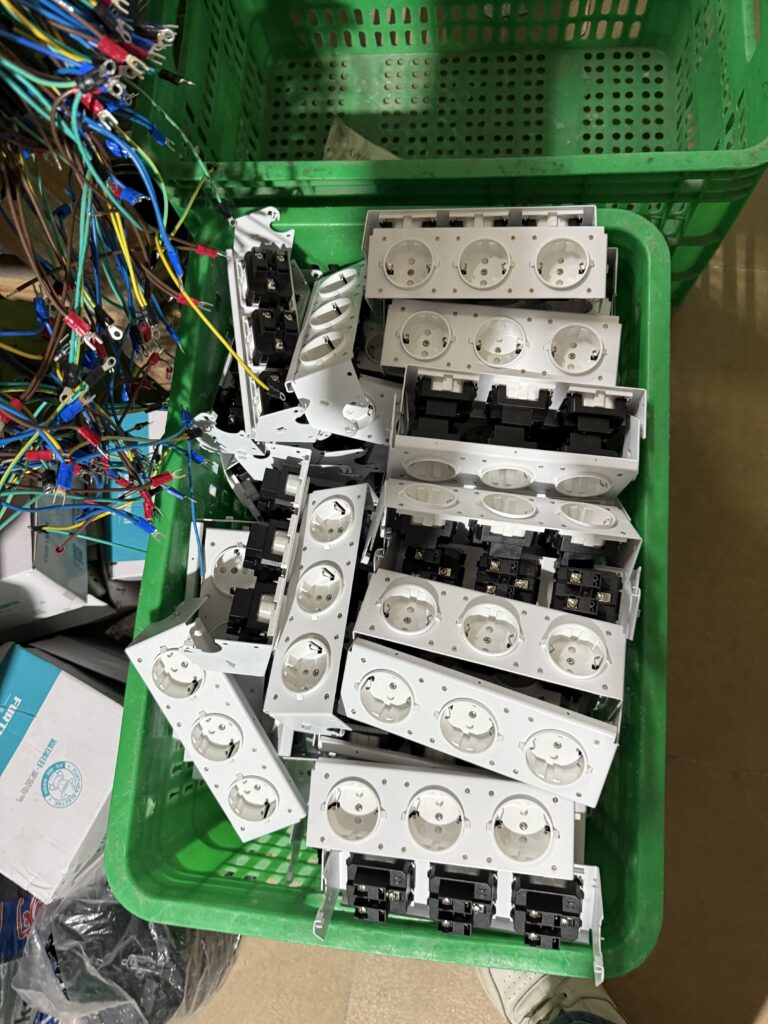
Stage 1: Component Incoming Inspection
Before assembly begins, every incoming component batch undergoes inspection against documented specifications. This covers:
- Spring mechanisms: Tested for consistent tension and cycle resistance before entering the assembly line
- Socket housings: Checked for dimensional accuracy against cutout template specifications — millimeter deviations at this stage cause installation problems in the field
- Contact materials: Phosphor bronze contacts inspected for plating thickness and surface quality
- Panel materials: Aluminum alloy and zinc alloy panels checked for surface finish consistency, dimensional accuracy, and absence of machining defects
Components that do not meet specification are quarantined and returned to the supplier. This incoming inspection step is the first line of defense against the quality inconsistency that often affects products sourced through traders rather than directly from factories.
Stage 2: Sub-Assembly
The mechanism assembly — springs, guides, and locking components — is built as a sub-assembly before the full unit is put together. This allows each mechanism to be functionally tested before it is enclosed in the housing.
Key precision points at this stage:
- Pop-up height calibration: the mechanism is set to deploy to the correct height relative to the panel face
- Resistance calibration: the activation force is adjusted to be firm enough to prevent accidental activation but smooth enough for one-handed operation
- Alignment: four-point guidance components are checked for symmetry to prevent wobble in deployment
Stage 3: Electrical Assembly
Socket contacts, PCBs, and wiring harnesses are installed by specialized workers following documented procedures. Color-coded wiring ensures correct polarity. Strain relief fittings are installed at all flex points to prevent conductor fatigue over thousands of activation cycles.
USB-C PD modules are installed and tested separately before integration — charging protocol negotiation is verified for correct wattage output with representative test devices.
Stage 4: Final Assembly and Function Testing
The completed unit undergoes 100% function testing before packaging. Every unit is tested for:
- Mechanical operation: activation and retraction cycle, flush fit when closed
- Electrical continuity: all outlets and USB ports verified for correct output
- Safety mechanisms: child safety shutters, overload protection, and surge protection circuits
Units that fail any test point are removed from the production flow for rework or rejection. This 100% inspection policy — rather than sampling — is what allows Moonian to provide consistent quality across production batches.
Stage 5: Cycle Testing for Commercial-Grade Models
Commercial-grade models undergo accelerated lifecycle testing as part of batch qualification. Units are cycled continuously at rated load to simulate years of daily commercial use. This testing validates that the production batch meets the cycle life specification — 30,000 to 50,000 cycles depending on the model — before any units are shipped.
What This Means for Your Product
When you source pop-up sockets from Moonian, you receive:
- Components that have been inspected before assembly, not just the finished product
- Mechanisms calibrated to consistent deployment force and height tolerances
- Electrical assemblies verified individually before integration
- 100% function-tested units — not a sampling-based QC process
- Complete certification documentation traceable to the specific production batch
For more on what to verify when evaluating any socket supplier’s quality system, see our supplier selection guide.
Want to see our production process firsthand? → Request a virtual factory tour → Browse our pop-up socket range → Read about our 100% quality inspection process