
The Complete Guide to Choosing and Installing Pop-Up Sockets for Wooden Desks

Wooden desks represent the heart of craftsmanship in furniture manufacturing, blending natural beauty with functional design. However, integrating modern technology like pop-up sockets into wood presents unique challenges that, if mishandled, can compromise both the desk’s integrity and the socket’s performance. This guide provides furniture makers with wood-specific expertise to achieve flawless, durable integrations that enhance rather than detract from their craftsmanship.
Why Wood Demands Special Attention: Material Science Meets Furniture Making
Unlike manufactured panels, solid wood is a living material that reacts to its environment. Understanding this is key to a successful installation:
- Movement & Seasonal Changes: Wood expands and contracts across the grain with changes in humidity. A cutout that’s perfect in summer may stress or gap in winter.
- Grain Direction & Stability: Cutting across the grain (end grain) vs. with the grain (long grain) affects stability and the risk of splintering or cracking.
- Hardness & Density Variability: A socket mechanism that works in soft pine may sit too loosely in dense oak without proper adjustment.
- Finishing Compatibility: The chemicals and processes in stains, oils, and lacquers must not interfere with the socket’s operation or materials.
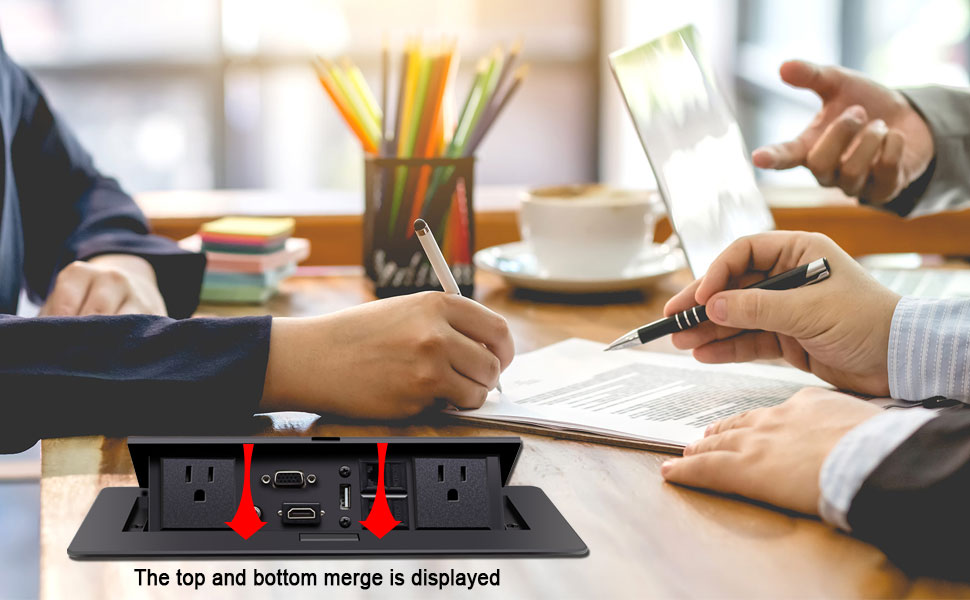
Step 1: Selecting the Right Pop-Up Socket for Wood
Your choice of socket must account for wood’s characteristics. Here’s a decision matrix:
| Wood Type & Desk Style | Recommended Socket Type | Key Rationale & Moonian Solution |
|---|---|---|
| Solid Hardwood (Oak, Walnut, Maple) – Premium Desk | Premium Pop-Up with Metal Bezel | The weight and stability of hardwoods pair with a solid-feeling mechanism. Our metal-finish pop-up sockets provide the requisite durability and aesthetic match. |
| Engineered Wood / Veneer – Modern Office Desk | Standard Pop-Up or Sliding Cover | Stable substrate allows for precise, clean cuts. A low-profile sliding cover socket complements a minimalist design. |
| Live Edge / Natural Wood – Statement Piece | Discreet Pop-Up with Custom Finish | The socket should not compete with the natural beauty. Our OEM services can match bezel finishes to hardware or provide a subdued, brushed metal option. |
| High-Use Commercial (Hotels, Coworking) | Heavy-Duty Pop-Up Mechanism | Wood in public spaces needs extra protection. A robust mechanism like our commercial-grade pop-up sockets withstands constant use without loosening in the wood. |
For a full comparison of socket types and their specifications, see our desktop socket types and features guide.
Critical Selection Factor: Mounting System
- Clamp-on Bracket (Ideal for Wood): Spreads mounting pressure over a wider area beneath the desktop, reducing the risk of cracking. This is our recommended method for solid wood over 22mm thick.
- Screw-on Flange: Suitable for very thick wood or engineered panels, but requires precise, deep pilot holes to avoid splitting.
Step 2: The Precision Installation Process (A Woodworker’s Guide)
Follow this process to ensure a professional, lasting result.
Phase A: Design & Layout
- Acquire the Template: Always use the manufacturer’s 1:1 paper or CNC template. For Moonian products, these are available upon request.
- Grain Awareness: Position the cutout template to avoid short grain sections at the corners, which are prone to breaking out. Orient the long side of the rectangle with the wood grain where possible.
- Thickness Verification: Measure your desktop’s exact finished thickness. The socket’s mounting bracket must be compatible. Most require a thickness between 25-40mm.
Phase B: The Critical Cutting Process
- For CNC: This is the gold standard. Program the exact cutout size and depth from the template. Use a sharp, down-cut spiral bit to minimize top-surface tear-out.
- For Manual Routing:
- Secure the template firmly with double-sided tape or clamps.
- Use a sharp plunge router with a guide bushing matched to your template.
- Make multiple shallow passes (2-3mm per pass), especially in hardwoods, to prevent burning and reduce stress on the bit and wood.
- Always rout in the correct direction (typically counter-clockwise) to avoid “climb cutting” and losing control.
Phase C: Finishing & Sealing
- This is the most important step for wood.
- Seal the Cutout: Before installing the socket, apply the same sealant, oil, or lacquer used on the desk top to all interior surfaces of the cutout. This prevents the raw wood from absorbing moisture and swelling, which could jam the mechanism.
- Allow Full Cure: Let the finish dry and cure completely before proceeding.
Phase D: Mechanical & Electrical Installation
- Dry-Fit the Mechanism: Place the socket into the cutout without final fastening. Ensure it sits flush and operates smoothly.
- Route the Cable: Drill a generous access hole (min. 25mm) from the cutout to the desk’s underside cavity. Deburr the hole entrance to prevent cable shearing.
- Secure with Care: If using screws into wood, always use properly sized pilot holes. Do not overtighten mounting screws, as this can compress the wood fibers and cause future looseness or cracking.
- Final Connection: Make electrical connections according to local regulations, typically within an accessory box under the desk.
Troubleshooting Common Wood-Specific Issues
| Problem | Likely Cause | Professional Solution |
|---|---|---|
| Socket feels loose or wobbles | 1. Cutout slightly oversized. 2. Wood compressed around screws. 3. Underside bracket not tight. | 1. Use thin, non-adhesive felt shims around the socket perimeter. 2. Move to a new mounting location slightly away from the original holes. 3. Ensure all lock nuts on the underside bracket are fully tightened. |
| Socket sticks or is hard to press | 1. Wood swelling from humidity. 2. Finish seeped into the mechanism. 3. Misaligned during installation. | 1. Remove socket, lightly sand the interior of the cutout, and re-seal. 2. Gently clean the socket’s outer casing with a suitable solvent before re-sealing the wood. 3. Loosen mounting, re-center, and re-tighten evenly. |
| Visible gap around the socket | Seasonal wood contraction. | This is normal in some climates. Choose a socket with a slightly oversized faceplate or a design that includes a separate trim ring to bridge the gap. |
| Crack emanating from cutout corner | Short grain or excessive stress during cutting/installation. | Unfortunately, this often requires a desk top repair. This is why grain direction and shallow routing passes are critical in the planning stage. |
For guidance on selecting the right socket material for wooden desk applications, see our aluminum vs zinc alloy guide.
The Moonian Advantage for Wood Furniture Makers
We design our products with real-world material challenges in mind:
- Forgiving Tolerances: Where possible, our designs account for minor material movement without compromising function.
- Robust Mounting Hardware: We supply appropriate fasteners and brackets designed to distribute load in wooden tops.
- Technical Support: Access to detailed dimensional drawings and consultation for complex or high-value projects via our Browse pop-up socket options → Request CAD drawings and samples
- Proven Partnerships: Our components are used by high-end furniture studios across Europe, attesting to their reliability in premium wooden furniture.

I like that you highlighted how wood movement across seasons can affect the fit of a pop-up socket—it’s something many builders overlook until gaps or stress cracks show up months later. Paying attention to grain direction during the cutout is another smart reminder, especially since tear-out can ruin the clean look people expect from a custom desk. It’s helpful to see installation framed through the lens of material behavior rather than just hardware placement.