
USB-C Power Delivery in Desktop Sockets: The Essential Guide for Future-Proof Furniture

The humble power outlet is undergoing its most significant revolution since the adoption of the standardized plug. USB-C Power Delivery (PD) is transitioning from a convenient phone-charging port to the primary power interface for modern workspaces. For furniture manufacturers, integrating genuine, high-wattage USB-C PD is no longer a speculative feature—it’s a critical requirement for staying relevant in markets like Europe and the Middle East, where technology adoption is rapid.
This guide cuts through the technical jargon to explain why USB-C PD matters, what specifications are crucial, and how to implement it correctly in your furniture designs.
The Market Shift: Why USB-C PD is Non-Negotiable
The driving force is clear: device convergence. Laptops, tablets, monitors, and even professional tools are standardizing on USB-C for both data and power.
- The Laptop Tipping Point: By 2025, over 92% of new laptops shipped globally will charge via USB-C. European corporate IT policies are increasingly mandating USB-C-only fleets for simplicity.
- The “One Cable” Workspace Dream: Professionals now expect to dock a laptop with a single cable that delivers power, video to dual monitors, data, and network connectivity. This is only possible with a capable USB-C port.
- Regulatory Pressure: Following the EU’s common charger directive, the push for universal charging is accelerating, making USB-C a long-term infrastructure investment.
Furniture without robust USB-C PD is, in essence, building obsolescence into the product from day one.
“For a broader overview of integrated socket options, see our complete desktop socket types guide.”
Beyond the Spec Sheet: Understanding Key USB-C PD Terminology
Not all USB-C ports are created equal. Here’s what furniture specifiers must understand:
| Term | What It Means | Why It Matters for Furniture |
|---|---|---|
| Power Delivery (PD) | The intelligent communication protocol that negotiates higher voltage and current. | Without PD, a USB-C port is limited to basic 5V/3A (15W) charging—useless for laptops. |
| Wattage (W) | The maximum power output (Volts x Amps). | Minimum 65W is required for most ultrabooks; 100W covers high-performance laptops and fast-charging multiple devices. |
| PPS (Programmable Power Supply) | An advanced part of the PD 3.0 standard that allows fine-grained voltage/current adjustment. | Crucial for optimally charging modern smartphones (like Samsung Galaxy) at their fastest possible rate. |
| Power Profile (e.g., 20V/5A) | The specific voltage and current combinations a port supports. | More profiles mean compatibility with a wider range of devices. |
| Multi-port Power Sharing | How a socket intelligently allocates a total power budget (e.g., 100W) across multiple ports. | Prevents overload and ensures connected devices get the power they need. |
The Critical Insight: A socket advertised with “USB-C” but lacking explicit “PD” and a wattage rating (65W, 100W) is functionally obsolete for the professional market.
Engineering for Reliability: Avoiding the Four Major Pitfalls
Integrating high-wattage USB-C PD into furniture presents unique engineering challenges that cheap modules fail to solve.
1. Thermal Management: The Silent Killer
- Problem: Converting AC power to high-wattage DC generates significant heat. Poorly designed modules overheat, throttle power output, or fail prematurely.
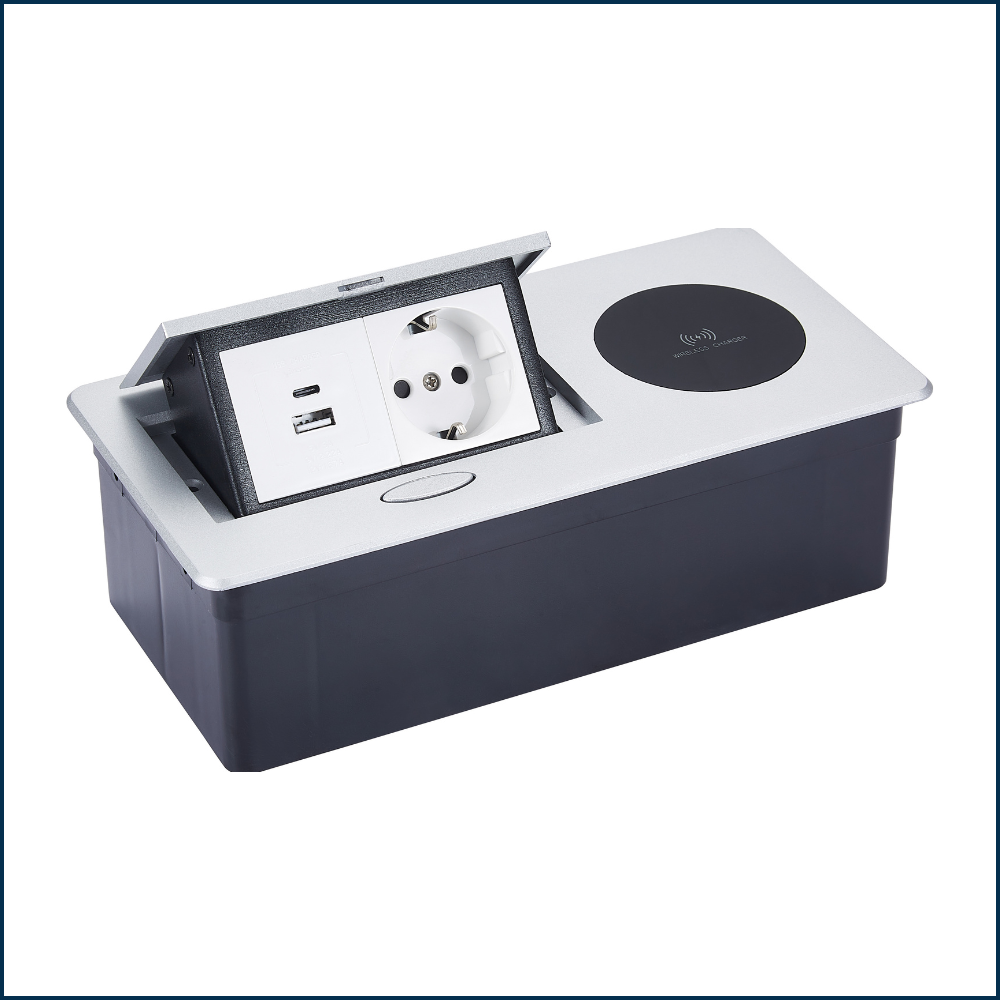
- Moonian Solution: Our pop-up desktop sockets with USB-C PD use metal housings as heat sinks and are designed with passive airflow channels. They are rated for continuous load at full specification, not just peak performance.
2. Power Integrity and Safety
- Problem: Fluctuating or “dirty” power can damage sensitive electronics. Lack of proper protection circuits is a liability.
- Moonian Solution: Our integrated circuits include over-voltage, over-current, short-circuit, and temperature protection, ensuring safe operation for connected €2,000+ laptops.
3. Physical Durability of the Port
- Problem: The USB-C port itself is a wear item. A loose or broken port renders the entire socket useless.
- Moonian Solution: We use reinforced, high-cycle port connectors mounted on secure PCBs, tested to withstand thousands of insertions in our heavy-duty commercial sockets.
4. User Confusion and Underutilization
- Problem: If users don’t know the port is high-power, they won’t use it, negating its value.
- Moonian Solution: We recommend and provide clear, laser-etched wattage labeling (e.g., “USB-C 100W PD“) next to the port, a small detail with massive UX impact.
Application Blueprint: Matching USB-C PD to Furniture Type
Use this matrix to specify the right solution for each product line:
| Furniture Application | Recommended USB-C PD Minimum | Moonian Product Integration | Key Rationale |
|---|---|---|---|
| Executive / Home Office Desk | 100W (Single or Dual Port) | High-end Pop-Up Socket | Powers laptop + fast-charges phone simultaneously. A premium, future-proof feature. |
| Conference / Meeting Table | 65W per seat zone | Power Track System with modules | Attendees can charge laptops during long sessions without hunting for adapters. |
| Kitchen Island / Residential | 30-65W (with PPS) | Sliding Cover Socket | Fast-charges tablets and modern smartphones while cooking or socializing. |
| Hot-Desking / Coworking | 100W Shared Power | Durable Multi-Port Sockets | Handles any member’s laptop. Robust construction for public use. |
| Educational / Library Desk | 45-65W | Cost-optimized, vandal-resistant models | Supports Chromebooks and tablets for digital learning environments. |
“For guidance on which socket material best handles high-power thermal demands, see our aluminum vs zinc alloy material guide.”
The Moonian Advantage: More Than Just a Port
We provide engineered power solutions, not just components. When you partner with us for your USB-C PD integration, you gain:
- Certified Safety & Compliance: Our modules are designed to meet CE, UKCA, and other international safety standards, simplifying your own product certification.
- OEM & Customization Flexibility: Need a specific wattage, port combination, or branding? Our OEM services can tailor the solution to your exact furniture design.
- Technical Documentation & Support: We provide clear specs, integration guides, and thermal performance data to make your design and engineering process seamless.
- Future-Ready Roadmap: We track evolving standards (like upcoming USB4 and higher wattages) so your products can evolve.
Call to Action for Furniture Manufacturers
Audit Your Current Lineup: Do your products offer genuine, high-wattage USB-C PD, or just basic charging ports?
Ask Your Supplier the Hard Questions:
- What is the continuous power rating of your USB-C module (not just peak)?
- Can you provide thermal performance graphs under full load?
- Are the modules independently certified for safety (UL, TÜV, etc.)?
- What is your policy on compatibility and firmware updates as standards evolve?
Prototype with the Right Partner: Integrate a truly professional-grade solution like Moonian’s and test it with the latest high-power laptops. Experience the difference in performance and reliability firsthand.
Ready to Future-Proof Your Furniture with Professional-Grade USB-C PD?
→ Explore Our USB-C PD Integrated Pop-Up Sockets
→ See High-Power Solutions for Commercial Furniture
→ Request Technical Specifications & CAD Files
For a full supplier evaluation framework before sourcing USB-C PD integrated sockets, see our 5-factor supplier selection checklist.