
Best Pop-Up Sockets for Wooden Desks: A Buyer’s Guide for Furniture Professionals

Wooden desks present a specific set of challenges for power integration. The natural beauty of solid wood, veneer, or engineered timber is exactly what buyers are paying for — and a poorly chosen socket can undermine it entirely. At the same time, wood’s structural properties require precise installation to avoid cracking, gaps, or instability in the mechanism over time.
This guide covers the five most important selection criteria for pop-up sockets in wooden desk applications, with specific recommendations for different wood desk types.
For a broader overview of all socket types and their specifications, see our desktop socket types and features guide.
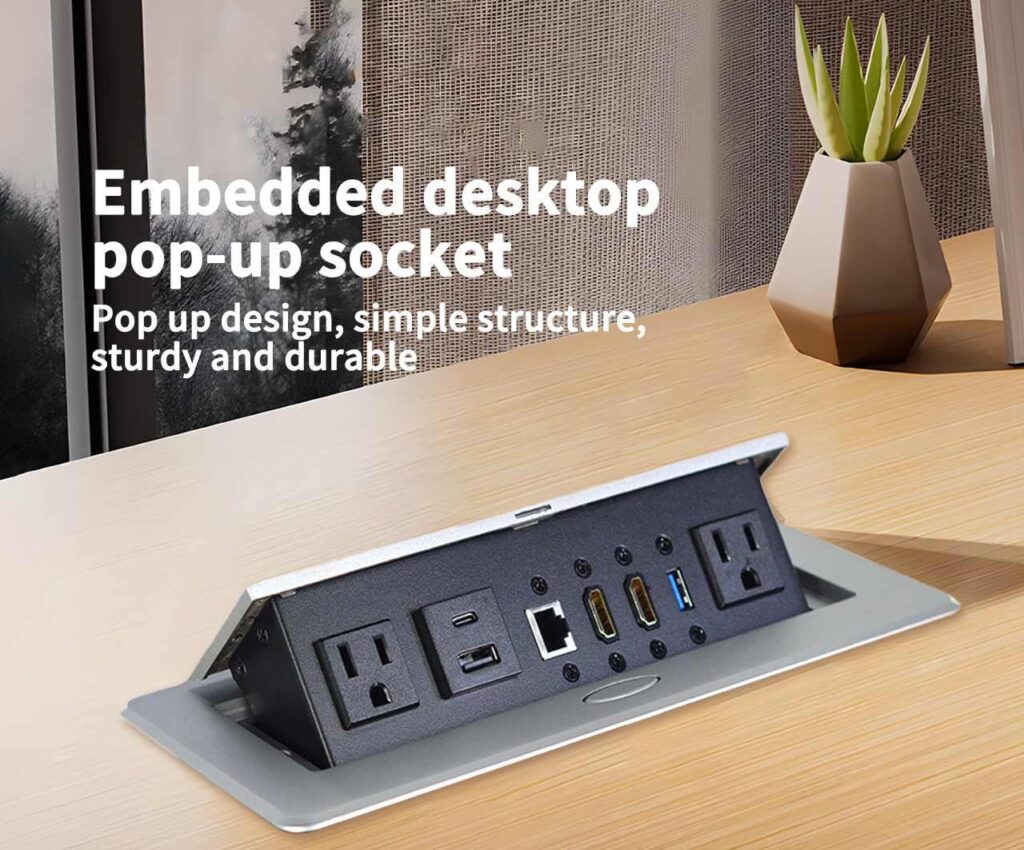
5 Key Selection Criteria for Wooden Desk Applications
1. Finish and Aesthetic Compatibility
Wood grains, textures, and tones vary enormously — from light Scandinavian oak to dark walnut to bleached ash. A socket finish that suits one desk will look wrong on another.
What to specify:
- Brushed aluminum in silver or space gray: suits contemporary and Scandinavian designs
- Anodized matte black: suits dark wood species and industrial-style furniture
- Champagne gold or brushed brass: suits warm-toned woods and traditional executive designs
- Custom RAL/Pantone matching: for furniture brands with a defined material palette
Avoid standard bright-silver or white plastic finishes on premium wooden furniture — they communicate budget hardware regardless of the desk quality underneath.
2. Installation Mechanism and Wood Compatibility
Wood requires a different approach to installation than metal or glass surfaces. The cutout must be precise, the mounting must be secure, and the mechanism must not transmit vibration back into the timber.
What to look for:
- Clip-on or screw-fixation mounting that distributes pressure evenly without cracking thin veneers
- CAD/BIM files and physical templates to guide precise cutout dimensions
- Compatibility with your specific tabletop thickness — typically 18mm to 50mm for wooden desks
- Felt or rubber gaskets that protect the wood surface from the socket’s mounting ring
A manufacturer that provides installation templates and technical drawings is significantly easier to work with than one that only provides a product photo.
3. Material Quality
The socket housing material directly affects longevity and thermal safety — both critical in wooden applications where heat buildup is a fire risk.
Recommended specifications:
- Anodized aluminum alloy panel: premium feel, superior scratch resistance, excellent heat dissipation
- Zinc alloy panel: good mid-range option with solid weight and feel
- Flame-retardant PC interior: required for all wooden desk applications — UL94 V-0 rated where possible
- Phosphor bronze contacts: superior conductivity and corrosion resistance vs. standard copper
Avoid polycarbonate-only housings for wooden desk applications — the lower thermal management capability is a risk, particularly for USB-C fast-charging applications.
4. Safety Certifications and Features
Wooden surfaces are particularly vulnerable to heat and electrical hazards. The safety specification for wooden desk applications should be higher than for metal or glass.
Non-negotiable features:
- CE and RoHS certification (UKCA for UK market)
- Surge protection (minimum 6kV)
- Child safety shutters on all AC outlets
- Flame-retardant housing materials
- Overload and short-circuit protection
Recommended additions:
- IP54 rating for kitchen island or workshop desk applications
- Anti-pinch protection on electric mechanism models
- Thermal management housing for sustained high-power charging
5. Port Configuration for the Intended Use
The port combination should match how the desk will actually be used — not just what sounds comprehensive in a catalog.
Office and executive desks: AC outlets (EU or UK) + USB-C PD 65W+ + USB-A. HDMI and Ethernet for conference tables.
Home office and study desks: AC + USB-C PD 45-65W + USB-A. Wireless charging integration increasingly expected.
Kitchen island desks: AC with GFCI protection + USB-A for phone charging. IP54 rated mechanism essential.
Collaborative and shared desks: Consider a pull pop-up socket for flexible positioning, or a power track socket for large surfaces.
Recommended Socket Types for Wooden Desks
For Premium Executive and Home Office Desks
Best choice: Pneumatic or electric touch-control pop-up desktop socket in anodized aluminum
The flush mechanism and premium housing match the quality of high-end wooden desks. The pneumatic version requires no motor and is highly reliable; the electric version offers touch activation and LED indicators for a more technological feel.
For Minimalist Scandinavian and Contemporary Designs
Best choice: Sliding cover socket in brushed silver or matte black
The horizontal sliding mechanism maintains an even lower profile than a pop-up, making it ideal for very thin tabletops or designs where any vertical protrusion would disrupt the visual flow.
For Shared Workstations and Collaborative Tables
Best choice: Pull pop-up socket or power track socket
The two-stage pull mechanism allows users to position the socket at the angle most convenient for their device. For long wooden conference tables, a power track system allows outlets to be positioned anywhere along the table length.
For Kitchen Islands
Best choice: IP54-rated pop-up socket with GFCI protection
Moisture resistance is the priority here. Finish should match countertop hardware — brushed brass or matte black are the most common choices for wooden kitchen island surfaces.
Installation Checklist for Wooden Desks
Before specifying a socket for a wooden desk application, confirm:
- Tabletop thickness is within the socket’s compatible range
- Cutout dimensions are available as a CAD template
- Mounting mechanism is compatible with your wood species and veneer thickness
- Sufficient clearance below the surface for the mechanism and cable routing
- Finish has been evaluated against the actual wood sample, not just a color chip
For a detailed installation walkthrough, see our guide on installing pop-up sockets in wooden desks.
Why Material and Finish Matching Matters More Than You Think
A wooden desk is often the most visible piece of furniture in a room. The socket is one of the few hardware elements that sits on the desk surface — directly in the user’s line of sight. A socket that looks like it was added as an afterthought will be noticed, and it will affect how the buyer perceives the entire piece.
Premium furniture buyers make decisions based on the quality they can see and touch. Getting the socket finish right is not a detail — it is part of the product.
For guidance on material specifications, see our article on aluminum vs zinc alloy in pop-up sockets.
Ready to specify the right socket for your wooden desk collection? → Browse our pop-up socket range → View sliding cover socket options → Request samples and technical drawings