
Pop-Up Sockets for Kitchen Islands vs Worktops: Which Do You Need?

Kitchen islands and kitchen worktops look like the same problem from a distance. Both are flat surfaces. Both need power. Both use pop-up sockets as the cleanest solution.
Up close, they are different projects with different requirements — different cable routing, different usage patterns, different specification priorities. Specifying a worktop socket for an island installation, or vice versa, produces results that work but do not work well.
At Moonian, we supply both applications. This guide clarifies the differences so you can specify correctly from the start.
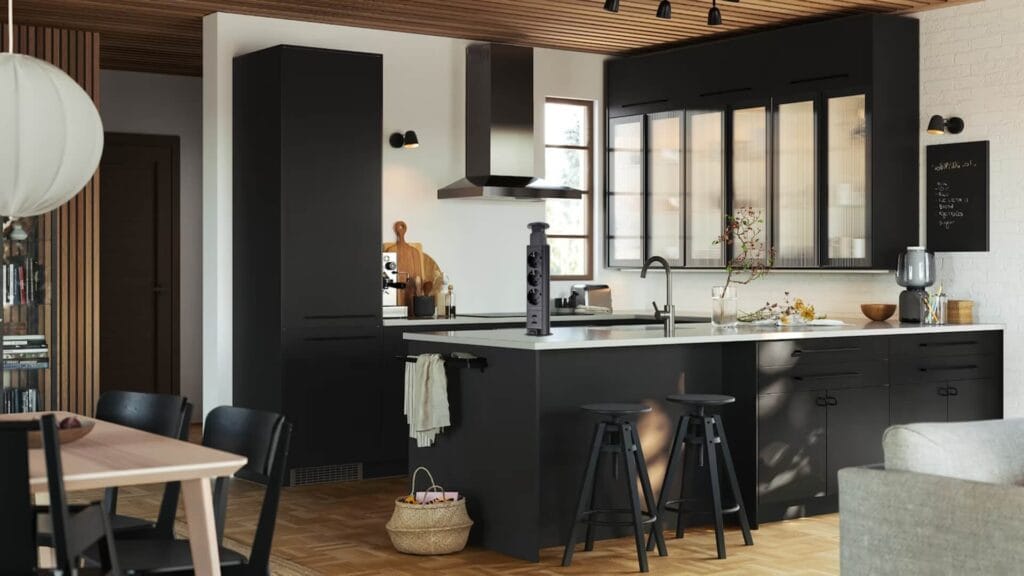
The Core Difference: How Power Gets There
The most fundamental difference between a kitchen island socket and a worktop socket is not the socket itself — it is the supply infrastructure.
A kitchen worktop runs along a wall. The supply cable routes through the back of a base cabinet to a wall-mounted connection point. This is standard domestic electrical installation: straightforward, well-understood, low additional cost.
A kitchen island stands free in the room. There is no wall behind it. The supply cable must come from below — through the floor via a conduit set into the screed, or through a floor box positioned at the island’s footprint. This floor supply decision is made during construction or renovation, not at fit-out stage. If it is not planned early, the options at installation stage are limited and expensive.
This single difference — floor supply vs wall supply — drives most of the downstream specification decisions.
Usage Patterns: What Each Surface Actually Does
Kitchen Worktop
A kitchen worktop is primarily a task surface. It is used for food preparation, small appliance use (kettle, toaster, blender), and occasional device charging. Usage is concentrated at specific times — morning, meal preparation, evening.
The socket on a worktop typically serves one user at a time, with predictable power needs. A standard configuration of 2 AC outlets plus USB-C PD 65W covers the majority of worktop use cases.
Kitchen Island
A kitchen island is a multi-function surface. It serves as a prep area, a dining surface, a homework station, a charging hub, and increasingly a home office workstation — often simultaneously for different users.
The socket on an island needs to serve more varied and concurrent demands. Two people charging phones while a third connects a laptop is a realistic island scenario. For islands that regularly double as work surfaces, USB-C PD 100W is the correct specification — not an upgrade, the baseline.
Specification Comparison
Socket Type
Both island and worktop installations use the same socket products. The choice between mechanism types follows the same logic for both:
Pop-Up Desktop Socket — spring-loaded, completely flush when closed. The preferred choice for premium installations where surface continuity matters. On a kitchen island that serves as the visual centrepiece of the room, the completely flat closed profile makes a visible difference.
Pull Pop-Up Socket — manual pull with dual-lock. The preferred choice where accidental activation is a concern. On a family island where children are regularly present, or on a worktop adjacent to the hob, the deliberate pull mechanism eliminates the risk of an accidentally open socket.
Number of Sockets
Worktop: One socket unit per independent worktop section is typically sufficient. For worktops longer than 2.5m, two units spaced along the length provide more flexible appliance positioning.
Island: Island length and seating configuration determine socket count:
- Under 1.2m: one socket, positioned towards one end
- 1.2–2.0m: one or two sockets depending on seating arrangement
- Over 2.0m or with seating on multiple sides: two sockets, or consider a surface power track running along the island spine
Outlet Configuration
| Application | Recommended Configuration |
|---|---|
| Standard worktop | 2 AC + USB-C PD 45W |
| Premium worktop | 2 AC + USB-C PD 65W |
| Standard island | 2 AC + USB-C PD 65W |
| Island with home office use | 3 AC + USB-C PD 100W |
| Commercial/hospitality island | 3 AC + USB-C PD 100W |
Cable Length
Standard Moonian socket cable tail: 1.5 metres.
For worktop installations, 1.5m is sufficient in most cases — the cabinet depth between the socket position and the wall connection point is typically 600mm or less.
For island installations, the cable must reach from the socket position down through the island structure to the floor supply entry point. In a tall island (900mm worktop height plus plinth), with the floor entry at the base, the internal cable run can exceed 1.2m before the tail begins. For islands over 800mm tall, specify extended cable tails at order stage — 2.0m or 2.5m depending on island height and internal structure.
Pro Tip: When supplying kitchen islands as furniture units, include the cable entry point and internal cable route in your production drawings, and confirm cable tail length with your socket supplier before the worktop is fixed. A cable length problem discovered after installation requires worktop removal to fix — the most expensive possible point to find it.
IP Rating
The IP rating requirement follows zone classification, not surface type. Most island and worktop positions fall outside Zone 1 and Zone 2 (more than 300mm from any water source), making IP20 standard sockets the correct specification.
The exception: worktop positions near the sink, or island designs where the sink is integrated into the island. For these positions, IP44 splash-resistant variants are required under UK wiring regulations.
Full IP rating guidance: Pop-Up Electrical Sockets for Kitchens.
Installation Requirements Side by Side
| Kitchen Worktop | Kitchen Island | |
|---|---|---|
| Supply route | Through cabinet back to wall | Through floor (conduit or floor box) |
| Supply decision timing | At fit-out stage | At construction/renovation stage |
| Cutout position | Along worktop length, away from sink zone | Central or end position on island top |
| Standard cable tail (1.5m) | Usually sufficient | May need extension (2.0–2.5m) |
| Number of sockets | 1 per section | 1–2 depending on length |
| Recommended USB-C | PD 65W minimum | PD 65W–100W |
| IP44 required | Only in Zone 1/2 | Only if sink integrated |
| OEM finish matching priority | Medium | High (island is visual centrepiece) |
Finish Matching: Why It Matters More on Islands
On a kitchen worktop, the socket is one element among many — taps, handles, appliances, tiles. A socket that does not perfectly match the hardware programme is noticeable but not dominant.
On a kitchen island, the socket is often the only hardware element on the top surface. In a well-specified kitchen where handles, taps, and appliances are coordinated to a single finish — brushed gold, satin nickel, matte black — a socket in a mismatched finish reads as an oversight.
Moonian’s OEM colour matching service addresses this directly. Custom panel finishes — matched to any hardware programme via powder coat or anodising — are available on orders from 500 units per SKU. For kitchen furniture ranges where the island is a hero piece, matched socket finishes are worth specifying.
Full OEM process: OEM Customisation Guide.
For material comparison: Aluminium vs Zinc Alloy Guide.
Quick Decision Guide
Specifying for a kitchen worktop? Standard pop-up desktop socket, aluminium panel, 2 AC + USB-C PD 65W, IP20 unless within 300mm of sink. Cable tail 1.5m. One unit per worktop section.
Specifying for a kitchen island? Pop-up desktop socket (or pull type if children present), aluminium panel, 2–3 AC + USB-C PD 65W–100W, IP20 unless sink integrated. Confirm cable tail length against island height before ordering. Consider OEM finish matching. One unit for islands under 1.2m; two for longer.
Not sure which you’re dealing with? If the surface connects to a wall, it is a worktop application. If it stands free in the room, it is an island application — and the floor supply infrastructure needs to be confirmed before socket specification begins.
Request Samples
Moonian ships kitchen socket samples to UK and European addresses within 15–20 working days. Sample packs for kitchen applications include pop-up desktop and pull pop-up variants in aluminium panel finish, with CE and UKCA certification documentation and installation drawings.
Contact Wenyue: WhatsApp: +86 15017527810 Email: wenyue@moonianhub.com
Or submit a project enquiry — we respond within 10 hours on working days.
Summary
Kitchen island and worktop pop-up socket installations use the same products but differ in supply infrastructure, cable routing, usage demands, and finish priority. Islands require floor supply planning at construction stage, longer cable tails, higher USB-C wattage, and closer attention to finish matching. Worktops follow standard installation practice with fewer constraints.
Both applications are well served by Moonian’s CE and UKCA certified pop-up socket range, with aluminium panels and USB-C PD up to 100W. OEM colour matching is available for projects requiring finish coordination.
Moonian Technology Media Limited is a B2B manufacturer based in Guangdong, China. We supply kitchen furniture manufacturers, fit-out contractors, and wholesale distributors across Europe and the Middle East. Factory: Gaoyao District, Zhaoqing, Guangdong. Production capacity: 4,000 units/day.