
Power Track Sockets: Why Modern Office Contractors Are Switching from Pop-Up Outlets

In the past two years, we have seen a consistent shift in how European office fit-out contractors specify desk power. Pop-up sockets — the fixed, flush-mount units that defined integrated power for the previous decade — are still being specified. But for a growing number of projects, contractors are moving to power track systems instead.
This is not a trend driven by aesthetics or novelty. It is driven by a specific set of project realities that fixed pop-up sockets handle poorly: flexible floor plans, modular furniture, multi-user bench desks, and corporate clients who reconfigure their spaces every 18 to 24 months.
This article explains the technical case for power track systems, where they outperform fixed pop-up sockets, and where pop-up sockets remain the better choice — so you can make the right specification decision for each project.
What Has Changed in Office Design
Five years ago, most commercial offices had assigned desks in fixed positions. Power specification was straightforward: one pop-up socket per workstation, positioned to serve a single known user with a known device setup.
That model has largely been replaced by activity-based working, hot-desking, and agile floor plans. A typical modern office fit-out now includes:
- Hot-desk zones where any employee can sit any day
- Collaborative benches serving 6 to 12 people simultaneously
- Reconfigurable meeting areas that change weekly
- Focus rooms that double as informal meeting spaces
In this environment, a fixed pop-up socket is a permanent infrastructure decision made for a temporary furniture arrangement. Every time the layout changes, the power provision either becomes inadequate or requires costly remediation work.
Power track systems were designed precisely for this problem.
What Makes Power Track Different
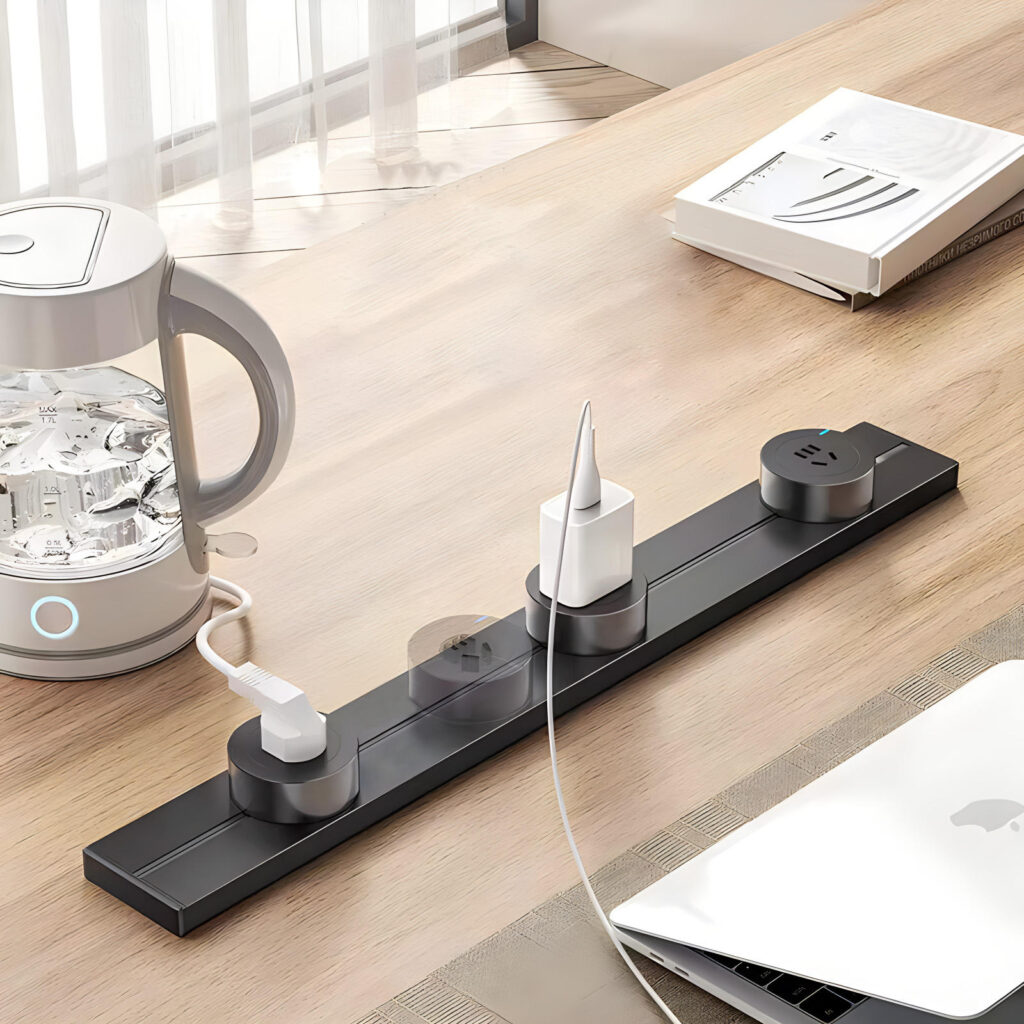
A power track system consists of two components: a fixed rail installed into or along the furniture surface, and modular socket adapters that clip onto the rail and can be repositioned anywhere along its length without tools.
The rail carries the electrical supply. The adapters — available in different outlet standards, USB configurations, and form factors — connect to the rail by a simple twist-lock mechanism and can be moved, added, or removed at any time.
This means the power configuration of a desk or table is never fixed. It changes with the furniture layout, with the user’s device needs, and with the client’s evolving workspace requirements.
Moonian manufactures two track installation types to suit different furniture construction methods:
MJX-S1 Recessed Power Track — installed flush within the desk surface for a completely integrated appearance. The track sits level with the tabletop, making it invisible when adapters are removed. Best for premium furniture where surface aesthetics are paramount.
MJX-S2 Surface Mounted Power Track — mounted on top of the desk surface or along the edge. Easier to retrofit to existing furniture and available with optional motion sensor LED strip and master switch. Best for fit-outs where installation speed and flexibility matter more than a fully flush finish.
Both are available in lengths from 400mm to 1500mm, in white, black, and grey finishes, with aluminium alloy construction throughout.
5 Reasons Contractors Are Making the Switch
1. One Installation, Infinite Configurations
With a fixed pop-up socket, the outlet is where it is. If the furniture layout changes and the socket ends up in the wrong position — between two users instead of adjacent to one — the only solution is to move the furniture around the socket, or accept a suboptimal power arrangement.
With a power track, the adapter moves to where the user is. A 1200mm track serving a bench desk can have its adapters redistributed in minutes when the seating arrangement changes. No tools, no electrician, no downtime.
For contractors managing fit-outs for clients who reconfigure frequently — law firms, creative agencies, tech companies — this eliminates a recurring friction point that would otherwise generate service calls and client complaints.
2. Scalable Power Density
A fixed pop-up socket has a defined number of outlets. If a client needs more power at a particular position — because a new employee uses three monitors instead of one, or because a conference table now hosts video equipment as well as laptops — the only option is to add another socket, which requires another cutout and another installation.
A power track scales by adding adapter modules. A bench desk that started with four adapters can have six next month without any structural modification. The rail capacity supports the additional load; the adapter simply clips on.
This scalability is particularly valuable in fast-growing businesses where headcount and device requirements change faster than furniture procurement cycles.
3. Mixed Outlet Standards Without Multiple Cutouts
A single power track rail can carry adapters with different outlet standards simultaneously: EU sockets next to UK sockets next to USB-C PD charging modules. For international businesses, co-working spaces, and conference rooms that host visitors from multiple countries, this eliminates the adapter clutter that fixed sockets with a single outlet standard create.
Moonian’s track adapter range covers all major standards:
- Blue-Dot Minimalist Adapter (φ65mm): EU standard, UK standard, universal socket, USB-A/A charger (10W), USB A+C fast charger (18W)
- Halo-LED Power Track Adapter (φ70mm): EU, UK, US, universal socket, USB-A/A (10W), USB A+C fast charger (18W) — with LED ring indicator
- Premium Aluminum Industrial Adapter (φ70mm): EU, UK, US standard sockets, USB-A/A (10W), USB A+C fast charger (18W) — premium aluminum outer ring in white, black, or grey
A single track installation can mix these adapter types in any combination, giving every user exactly the outlet standard they need without requiring separate socket cutouts for each standard.
4. Lower Total Installation Cost on Large Projects
For individual workstations, a fixed pop-up socket is typically the more economical choice — the unit cost is competitive and the installation is straightforward.
For large bench desk installations, the economics shift. A 10-person bench desk with fixed pop-up sockets requires 10 individual cutouts, 10 individual wiring connections, and 10 individual units. A power track installation requires one rail, one wiring connection to the rail, and 10 adapter modules that clip on without tools.
The labour saving on a large open-plan fit-out is significant. Several contractors we supply have reported installation time reductions of 40–60% on bench desk projects after switching from fixed sockets to track systems.
5. Future-Proof Against Changing Device Standards
USB-C Power Delivery is now the dominant laptop charging standard in Europe. But charging standards continue to evolve — higher wattage requirements, new connector formats, and new protocol standards are a predictable feature of the device landscape.
With a fixed pop-up socket, upgrading the USB specification means replacing the entire unit — another cutout, another installation, another cost.
With a power track, upgrading means swapping an adapter module. When 100W USB-C PD becomes the standard expectation, the track rail remains in place and the adapter is replaced. This modularity is a genuine lifecycle advantage that becomes more valuable as device standards continue to evolve.
Where Pop-Up Sockets Remain the Better Choice
A balanced specification guide has to acknowledge where fixed pop-up sockets outperform tracks — and there are genuine cases.
Individual executive workstations. A single-user desk with a fixed position and a consistent device setup does not benefit from track flexibility. A premium pop-up desktop socket in anodized aluminum delivers a cleaner aesthetic and a lower unit cost for this application.
Thin tabletop designs. Power track rails require a minimum installation depth that some slim tabletop designs cannot accommodate. For furniture with tabletops under 25mm, a low-profile pop-up or sliding cover socket is often the only viable option.
Applications requiring IP-rated protection. Kitchen islands and outdoor-adjacent furniture applications require IP54-rated power solutions. Current track systems are not IP-rated; for moisture-exposed applications, a rated pop-up socket is the correct specification.
Budget-constrained residential projects. For residential furniture where track flexibility is not required and budget is the primary constraint, a standard pop-up socket delivers better value per outlet.
For a full comparison of all socket types and their applications, see our desktop socket types and features guide.
The Specification Decision Framework
Use this framework to choose between track and fixed socket for each project:
| Project Characteristic | Better Choice |
|---|---|
| Fixed single-user workstation | Pop-up socket |
| Hot-desk / activity-based working | Power track |
| Bench desk 6+ seats | Power track |
| Conference table, fixed layout | Pop-up socket |
| Conference table, flexible layout | Power track |
| Executive desk, premium aesthetic | Pop-up socket |
| Co-working space | Power track |
| Kitchen island | IP-rated pop-up socket |
| Client expects frequent reconfiguration | Power track |
| Thin tabletop under 25mm | Sliding cover socket |
What to Confirm Before Specifying a Power Track System
Rail length and coverage. Confirm the total desk length and the number of users to be served. As a rule of thumb, one adapter per user position plus one spare per 4 users for guests and additional devices.
Installation method. Recessed (S1) requires routing into the desk surface during manufacturing — specify this before production. Surface mounted (S2) can be retrofitted to existing furniture.
Load capacity. Confirm the total electrical load of connected devices against the rail’s rated capacity. Our tracks are rated for standard commercial loads; for high-draw applications (AV equipment, multiple high-power laptops), confirm with your electrician.
Adapter selection. Choose adapter types based on the outlet standards required in the target market. For European offices, EU standard plus USB-C fast charge covers the majority of users. For international environments, add UK and US adapters as needed.
Certification. All Moonian power track products carry CE and RoHS certification. Full documentation is available on request for procurement teams.
For guidance on evaluating any track socket supplier’s certification documentation, see our supplier evaluation checklist.
Conclusion
The shift toward power track systems in commercial office fit-outs is not a passing trend. It is a rational response to the reality of modern office design: layouts change, device needs evolve, and the power infrastructure needs to keep up without requiring structural intervention every time it does.
For furniture manufacturers and contractors working on open-plan offices, co-working spaces, collaborative environments, and any project where flexibility is a client requirement, power track systems deliver capabilities that fixed pop-up sockets fundamentally cannot match.
For projects where a single user, a fixed position, and a consistent device setup are the reality, the pop-up socket remains the right answer.
The best specifications use both — track systems where flexibility is needed, fixed sockets where it is not.
💡 Pro Tip: Moonian’s S1 and S2 power tracks are available in custom lengths from 400mm to 1500mm. Request a sample kit and specification sheet →
Ready to specify power track systems for your next project? → View the MJX-S1 Recessed Power Track → View the MJX-S2 Surface Mounted Power Track → Browse all track adapters → Request samples and CE documentation