
Co-Working Space Furniture Power Solutions: What Operators and Manufacturers Need to Know

Co-working spaces have become one of the fastest-growing segments of the commercial real estate market. From single-location independents to global networks with hundreds of sites, operators are competing on the quality and flexibility of the environments they offer. Members choose co-working spaces based on speed of connectivity, comfort of furniture, and — increasingly — the reliability and accessibility of power.
For furniture manufacturers supplying this market, co-working spaces present a distinctive set of requirements. They combine the high-usage intensity of a commercial office with the aesthetic expectations of a hospitality environment and the flexibility demands of a shared workspace. Getting the power specification right is essential to winning and retaining contracts with co-working operators.
This guide covers what makes co-working spaces different, the socket solutions that work best for each furniture category within a co-working environment, and the technical specifications that matter most.
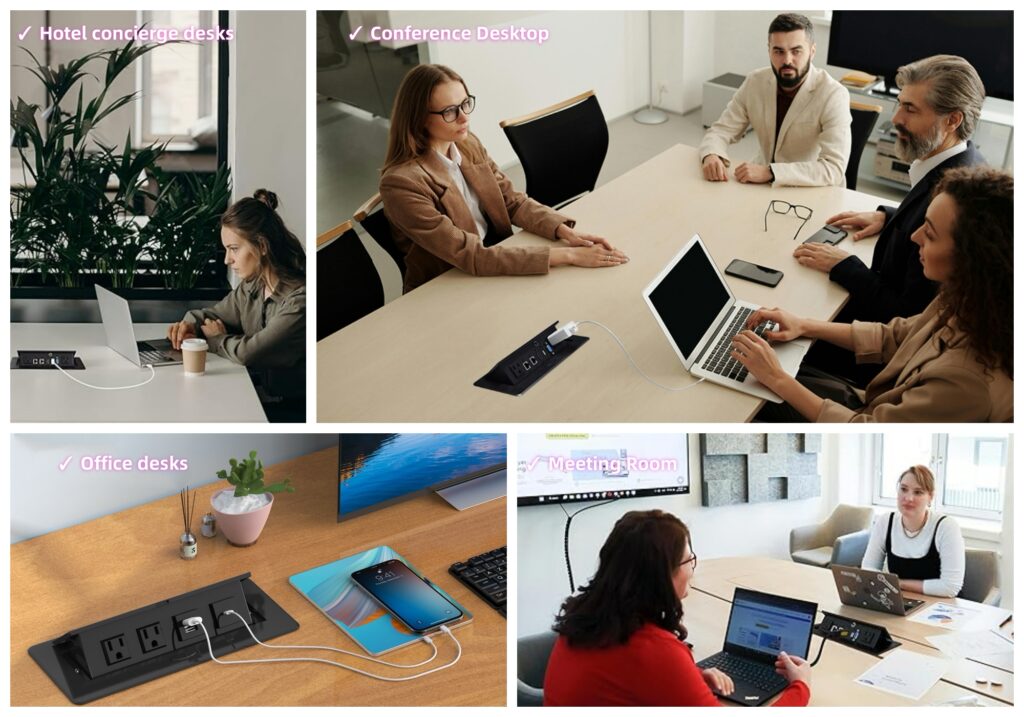
Why Co-Working Spaces Are Demanding Environments for Desk Power
Co-working spaces place unusual demands on integrated power components for three reasons that overlap and compound each other.
Maximum usage intensity. A hot desk in a busy co-working space may be occupied by three or four different members in a single day, each activating the desk socket multiple times. Unlike a corporate office where a desk is used by one person for one shift, co-working desks are genuinely shared infrastructure — operated at close to 100% occupancy during peak hours. The activation frequency is among the highest of any commercial furniture application.
Operator expectations for zero downtime. Co-working operators charge members a premium for a curated, reliable workspace experience. A desk socket that stops working is not a minor inconvenience — it is a direct failure to deliver the core product promise. Operators have low tolerance for maintenance issues that disrupt member experience, and furniture manufacturers whose components fail prematurely lose contracts.
Aesthetic standards borrowed from hospitality. The most successful co-working spaces are designed to feel more like boutique hotels than traditional offices. Visible power strips, cables on desk surfaces, or socket mechanisms that look cheap undermine the premium positioning that operators use to justify their pricing. Power integration must be invisible when not needed and premium in quality when used.
Socket Solutions by Co-Working Furniture Category
Co-working spaces contain multiple furniture categories, each with different power requirements. Here is how to approach each one.
Hot Desks: The Core Product
Hot desks are the most common furniture type in any co-working space and the most important to get right. Members spend the majority of their time here, and their experience of the desk power directly shapes their perception of the space.
Recommended solution: Commercial-grade pop-up desktop sockets with USB-C PD and standard AC outlets.
Why:
- The push-to-open mechanism is immediately intuitive for any user — no instruction required, which matters in a space used by members from many different backgrounds
- Flush closed position maintains the clean desk surface that co-working operators require for photography and marketing, and that members expect from a premium workspace
- Commercial-grade mechanisms at 30,000–50,000 cycles are essential given the activation frequency of a hot desk used by multiple members daily
- Mixed EU + UK outlet configuration covers the international member population typical of urban co-working locations
Placement: One socket per desk as a minimum. For wider collaborative desks shared by two members side by side, one socket per person is the correct specification.
For a full overview of socket types and mechanism options, see our desktop socket types and features guide.
Bench Desks and Collaborative Workbenches
Long bench desks — typically seating 6 to 12 members along a single continuous surface — are a staple of co-working spaces. They serve both as hot-desking rows and as informal collaboration areas.
Recommended solution: Power track socket systems running the length of the bench, or pop-up sockets at regular intervals.
Why track systems work well for bench desks:
- A track running beneath the bench edge allows outlet modules to be positioned anywhere along the bench length, accommodating different seating configurations and member preferences
- As membership patterns change and peak usage areas shift, outlet density can be adjusted without any structural modification
- For co-working operators managing multiple sites, a standardized track system allows consistent power provision regardless of how individual site layouts vary
Why fixed pop-up sockets are also suitable:
- For bench desks with defined workstation positions, a pop-up socket at each position provides the cleanest aesthetic and the most straightforward user experience
- Fixed positions eliminate the possibility of gaps in coverage that can occur if track modules are not distributed optimally
Private Offices and Dedicated Desks
Private offices and dedicated desk areas within co-working spaces serve members who pay a premium for exclusivity and a higher specification environment. The power requirements here are closer to a premium corporate office than a shared hot-desk area.
Recommended solution: Pull pop-up sockets or electric touch-control pop-up sockets with 100W USB-C PD.
Why:
- Private office members typically use higher-specification equipment — including high-performance laptops that require 100W USB-C PD for full-speed charging
- The premium mechanism quality communicates value appropriate to the higher price point of private office membership
- Pull pop-up mechanisms with 360° rotation allow members to position the socket optimally for their specific desk setup without being constrained by a fixed activation direction
- Wireless charging integration is increasingly expected at this membership tier
Phone Booths and Focus Pods
Acoustic phone booths and focus pods — small enclosed spaces for calls and concentrated work — are a fast-growing furniture category in co-working spaces. Members use them for video calls, confidential conversations, and deep-focus work sessions.
Recommended solution: Single pop-up socket or sliding cover socket with USB-C PD and standard AC outlet.
Why:
- A single well-positioned socket covers all power needs in a confined space — laptop charging, phone charging, and occasional peripheral power
- Sliding cover sockets are particularly appropriate for focus pods where silent operation matters — the horizontal sliding mechanism produces minimal sound compared to a pneumatic pop-up
- The compact footprint of both socket types suits the limited surface area available in most phone booth designs
Lounge and Informal Collaboration Areas
Lounge areas — sofas, armchairs, low tables — serve members who want a less formal working environment for calls, reading, or informal meetings. Power in these areas is often an afterthought, which creates frustration for members who need to charge while working in a lounge setting.
Recommended solution: Sliding cover sockets integrated into coffee tables and side tables, or pop-up sockets in occasional tables at seated height.
Why:
- Lounge furniture prioritizes aesthetics — sliding cover sockets with minimal profile and silent operation complement the design language of premium lounge furniture without visual intrusion
- USB-C PD at 45–65W covers the phone and lightweight laptop charging typical of lounge use
- Wireless charging integrated into tabletop surfaces is an increasingly popular specification for co-working lounge areas, eliminating cables entirely for compatible devices
Meeting Rooms
Meeting rooms within co-working spaces serve both members and their clients and guests. Power requirements are similar to a corporate conference room but with the added consideration that users are entirely unfamiliar with the specific installation.
Recommended solution: Pop-up sockets at one per two seats, with mixed outlet standards and USB-C PD. For larger rooms, power track systems for flexibility.
For a full guide to meeting room power specification, see our conference room power solutions article.
Technical Specifications for Co-Working Furniture Power
Cycle Life: The Non-Negotiable Parameter
Given the high daily activation frequency of co-working furniture, cycle life is the most critical specification. A hot desk socket used by three members per day, with two activations each, accumulates approximately 2,000 activations per year. Over a 10-year asset lifecycle, that is 20,000 cycles.
Specifying commercial-grade mechanisms at 30,000 cycles minimum — and 50,000 cycles for the highest-use positions — is essential. Residential-grade sockets at 10,000 cycles will fail before the end of the furniture’s expected service life. For more detail on commercial durability requirements, see our durable sockets for commercial furniture guide.
USB-C Power Delivery
Co-working members charge laptops at their desks. The minimum USB-C PD specification for hot desks is 65W, covering most ultrabooks and mid-range laptops. For private offices and dedicated desk areas, 100W is the appropriate specification.
Sockets with USB-C ports that deliver only 5W or 15W are a common source of member complaints in co-working spaces — members plug in expecting laptop charging and find their battery continuing to drain. Always confirm the wattage output, not just the presence of a USB-C port.
For a complete guide to USB-C PD specifications, see our USB-C Power Delivery guide.
International Outlet Compatibility
Co-working spaces in major European cities attract members from across Europe and internationally. A socket that accepts only one plug standard will require adapters for a significant proportion of members. Mixed EU + UK configuration in a single socket unit is the practical standard for urban co-working locations. For spaces serving a particularly international membership, universal outlet formats should be considered.
Safety Certifications
CE and RoHS certification is required for any electrical component in furniture sold into EU markets. UKCA is additionally required for UK co-working spaces. Co-working operators increasingly request certification documentation as part of their procurement process — operators who have faced insurance or liability issues are particularly careful about this.
For guidance on verifying supplier certification documentation, see our supplier evaluation checklist.
Ease of Maintenance
Co-working operators manage facilities across multiple sites, often with small maintenance teams. Socket components that require specialist tools or significant disassembly to replace create disproportionate maintenance burdens. Specifying sockets with:
- Accessible mounting hardware reachable from beneath the desk
- Modular construction that allows the mechanism to be replaced independently of the panel
- Clear installation documentation that a non-specialist can follow
reduces the total cost of ownership for the operator and reflects positively on the furniture manufacturer.
What Co-Working Operators Look for When Specifying Furniture
Understanding the operator’s perspective helps furniture manufacturers position their products more effectively.
Reliability above aesthetics. Operators have been burned by beautiful furniture with failing power components. A track record of reliable performance matters more than design novelty when an operator is committing to a 200-desk fit-out.
Consistent quality across volume. Co-working operators frequently fit out multiple sites from a single furniture contract. The quality of unit 500 must match unit 1. This is a direct argument for factory-direct sourcing over trading company procurement — see our direct sourcing vs traders analysis.
OEM customization for brand consistency. Established co-working brands have strong visual identities. Operators who have invested in developing a distinctive aesthetic want power components that complement — not contradict — that identity. Custom finish colors, logo integration, and port configurations tailored to the membership profile are all relevant for operators at scale.
For more on OEM customization options, see our OEM customization guide.
A Specification Checklist for Co-Working Furniture Power
Before finalizing any co-working furniture power specification, confirm:
- Mechanism cycle rating: 30,000+ cycles for hot desks, 50,000 for highest-use positions
- USB-C PD wattage: 65W for hot desks, 100W for private offices
- Outlet standards: EU + UK mixed configuration for international membership
- Safety certifications: CE and RoHS (plus UKCA for UK locations)
- Socket density: 1 per person for hot desks, 1 per 2 seats for meeting rooms
- Maintenance accessibility: confirmed for replacement without specialist tools
- Aesthetic compatibility: finish options reviewed against operator brand guidelines
- CAD drawings: obtained and verified against furniture design
Conclusion
Co-working spaces are one of the most commercially attractive markets for furniture manufacturers who can deliver reliable, premium integrated power. The combination of high-volume procurement, consistent repeat business, and operators’ willingness to pay for quality creates a market where getting the specification right has an outsized return.
The requirements are clear: commercial-grade durability, USB-C PD at the correct wattage, international outlet compatibility, and CE/RoHS certification. Furniture manufacturers who meet these requirements consistently — and who can support operators with OEM customization for brand consistency — will find themselves well positioned as this market continues to grow.
For context on the broader market trends driving demand for integrated power across commercial environments, see our 2026 office design trends article.
Ready to specify integrated power for your co-working furniture line? → Browse our pop-up socket range → View power track systems for bench desks → See sliding cover sockets for lounge furniture → Request samples and CE certification documents