
5 Office Design Trends Driving Demand for Integrated Desk Power in 2026

The way offices are designed has changed more in the past five years than in the previous twenty. Hybrid work, wellness-focused interiors, the hospitality crossover, and tightening sustainability requirements are reshaping what buyers expect from commercial and residential furniture alike.
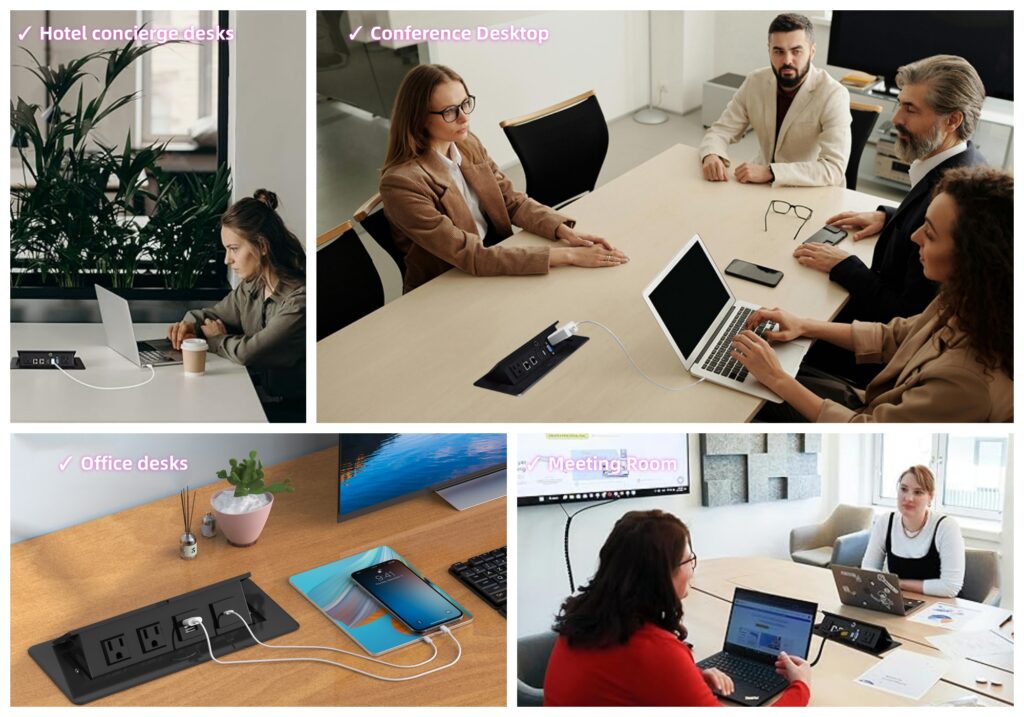
For furniture manufacturers and wholesalers, these trends have a direct consequence: the specification of integrated power solutions — pop-up sockets, sliding cover sockets, pull pop-up mechanisms, and power track systems — is no longer optional in premium product lines. It is increasingly the deciding factor in whether a piece of furniture wins or loses a specification.
This article breaks down the five most significant office design trends of 2026 and explains exactly how each one is driving demand for integrated desk power.
Trend 1: The Permanent Hybrid Work Infrastructure
The hybrid work debate is settled. Most knowledge workers now split time between home and office, and both environments are being permanently upgraded to professional standards.
What this means for furniture:
Home offices are no longer acceptable as converted spare rooms with a laptop on a dining table. Professionals working from home expect the same cable management, charging capability, and desk functionality they have at the office. This has created a massive residential market for furniture that was previously only specified in commercial projects — desks with integrated pop-up sockets, sufficient USB-C Power Delivery for laptops, and clean cable management built into the structure.
At the office end, hybrid work has created the hot-desking and activity-based working model, where no single employee “owns” a desk. Every desk must be ready for any user, with any device, at any time. This demands integrated power that works internationally — mixed EU/UK/US outlet configurations, USB-C PD at 65W or above, and mechanisms robust enough for daily use by rotating users.
The integrated power implication:
Furniture manufacturers targeting both residential and commercial markets are now specifying the same integrated power components across product lines. The residential buyer wants the same quality as the contract buyer. For more on what integrated power looks like in home office furniture, see our built-in power for home office guide.
Trend 2: The Death of the Cable on the Desk Surface
Cable management has moved from a “nice to have” to an absolute requirement in any furniture specification aimed at the mid-to-high end. The visual standard has shifted: a desk with visible cables is now perceived as poorly designed, not just untidy.
What is driving this:
Open-plan offices are increasingly photographed and shared on design platforms and social media. Hotel lobbies, co-working spaces, and corporate showrooms are curated to a level of visual precision that was previously reserved for retail interiors. Cables on desk surfaces are incompatible with this standard.
Survey data consistently supports this shift. 84% of European office managers now list integrated cable management as a “must-have” when specifying new workstations — above ergonomic features, storage, and even price in some segments.
The integrated power implication:
A power strip sitting on or under a desk surface is no longer an acceptable answer. The only solutions that meet the new cable-free standard are those that integrate power directly into the furniture structure — pop-up sockets, sliding cover sockets, and power track systems that eliminate visible cable runs entirely.
For furniture manufacturers, this is both a pressure and an opportunity. Brands that can deliver a genuinely cable-free desk surface command higher prices and win specifications that their competitors cannot. For a complete guide to designing furniture that meets this standard, see our hidden cable management guide.
Trend 3: The Hospitality Crossover in Office Design
One of the most significant shifts in commercial interior design over the past three years is the deliberate blurring of the line between office and hospitality environments. Corporate offices are being designed to feel like premium hotels — with lounge areas, café-style collaboration zones, and private booths that feel more like boutique hotel rooms than traditional workspaces.
What this means for furniture:
The hospitality crossover brings hospitality-grade specification standards into the office. Hotel furniture has always demanded integrated power — guests expect to charge devices from the bedside table, the desk, and the lounge chair without searching for a socket. When office designers adopt hospitality aesthetics, they adopt hospitality power standards along with them.
This means pop-up sockets in conference tables, sliding cover sockets in lounge seating tables, wireless charging integrated into surfaces, and mechanisms that operate silently — the pneumatic or electric activation standards that have been normal in hotel rooms for years are now being specified for office environments.
The integrated power implication:
Furniture manufacturers supplying both the hospitality and commercial office markets are finding that the specification requirements of both sectors are converging. A sliding cover socket that meets the requirements of a five-star hotel room desk increasingly also meets the requirements of a premium corporate office lounge.
For more on socket solutions specifically for hospitality environments, see our hotel socket solutions guide. For the office furniture perspective, see our guide to integrated sockets for European manufacturers.
Trend 4: USB-C as the Universal Standard — and the Furniture That Is Not Ready for It
The USB-C transition is complete at the device level. By 2026, the overwhelming majority of laptops, tablets, and professional tools charge exclusively via USB-C. The EU’s common charger directive has accelerated this in Europe, and the rest of the world is following.
The problem:
A significant proportion of furniture currently in offices and homes was specified before USB-C Power Delivery became the dominant laptop charging standard. Much of it has no USB-C port at all, or has USB-C ports that deliver only 5W — sufficient for charging phones slowly, but completely inadequate for laptops.
This is creating a replacement cycle that furniture manufacturers are well positioned to benefit from. Businesses upgrading workstations for hybrid work are discovering that their existing furniture cannot support their new device fleet without power adapters cluttering the desk — defeating the cable management purpose of the integrated socket entirely.
The integrated power implication:
Any furniture specification for 2026 and beyond that does not include USB-C Power Delivery at minimum 65W is already behind the market. For executive desks and conference table applications, 100W is the correct specification. For furniture manufacturers, this means specifying pop-up sockets and power track systems with verified USB-C PD capability — not just a USB-C port that delivers inadequate wattage.
For a complete technical guide to USB-C PD specifications in furniture, see our USB-C Power Delivery essential guide.
Trend 5: Sustainability and Longevity as Procurement Criteria
Environmental, Social, and Governance (ESG) commitments are now standard for large European and Middle Eastern corporations, and they are increasingly flowing down into procurement decisions — including furniture specifications.
What buyers are looking for:
Sustainability in furniture procurement is no longer just about material sourcing. It encompasses product longevity, repairability, and the avoidance of built-in obsolescence. A desk that needs to be replaced because its integrated power module failed after three years is not a sustainable product — it is a liability.
This is creating specific demand for integrated power components that are:
- Rated for commercial lifecycle: 30,000 to 50,000 activation cycles, not the 10,000-cycle residential standard
- Modular and serviceable: components that can be replaced without replacing the entire desk
- Certified and documented: CE, RoHS, and UKCA certification with traceable batch documentation, which satisfies both regulatory compliance and ESG reporting requirements
- Future-compatible: USB-C PD today, with the capacity to accommodate evolving standards
The integrated power implication:
Furniture manufacturers whose integrated power components fail prematurely are increasingly facing ESG-related objections from corporate buyers. Specifying commercial-grade components from the outset — with documented certification and lifecycle testing — is becoming a competitive requirement, not just a quality preference.
For more on what commercial-grade durability looks like in practice, see our durable sockets for commercial furniture guide. For guidance on verifying a supplier’s quality credentials, see our supplier evaluation checklist.
What These Trends Mean for Your Product Line
Taken together, these five trends point in a single direction: integrated desk power is moving from a premium add-on to a baseline requirement across a widening range of furniture categories and price points.
The manufacturers who will benefit most are those who:
- Integrate power planning into the design phase, not as a retrofit — see our guide on avoiding the #1 power integration mistake
- Specify components that meet commercial lifecycle requirements, not just residential standards
- Offer USB-C PD at the wattages the market now requires
- Can demonstrate certification and quality documentation to ESG-conscious buyers
- Work with a factory-direct supplier with genuine OEM capability — see our direct sourcing vs traders analysis
The demand is there and growing. The question is whether your product line is positioned to capture it.
How Moonian Supports Furniture Manufacturers in 2026
Moonian has supplied integrated power components to furniture manufacturers and wholesalers in Europe and the Middle East since 2018. Our range covers all the socket types that these five trends demand — pop-up sockets, sliding cover sockets, pull pop-up sockets, and power track systems — all CE and RoHS certified, with USB-C PD options up to 100W.
Our OEM service covers custom finishes, port configurations, and branding, with sample lead times of 15–20 working days. For more on our OEM capabilities, see our OEM customization guide.
Ready to future-proof your furniture line? → Browse our full socket range → Request samples and technical drawings → Read our market analysis for Europe and the Middle East