
Sliding Cover vs Pop-Up Sockets: Which Is Right for Your Furniture Project?

Two products. One job. Completely different ways of doing it.
The sliding cover socket and the pop-up socket are both designed to deliver mains power from a flat furniture surface without a fixed socket visible when not in use. That is where the similarity ends. The mechanism, the installation requirements, the use cases, and the aesthetic result are different enough that specifying the wrong type for a project creates problems that show up on the finished piece.
At Moonian’s factory in Guangdong, we manufacture both types and ship them to furniture manufacturers across the UK, Germany, and the Middle East. This guide is written to help procurement teams and product designers choose correctly — the first time.
How Each Mechanism Works
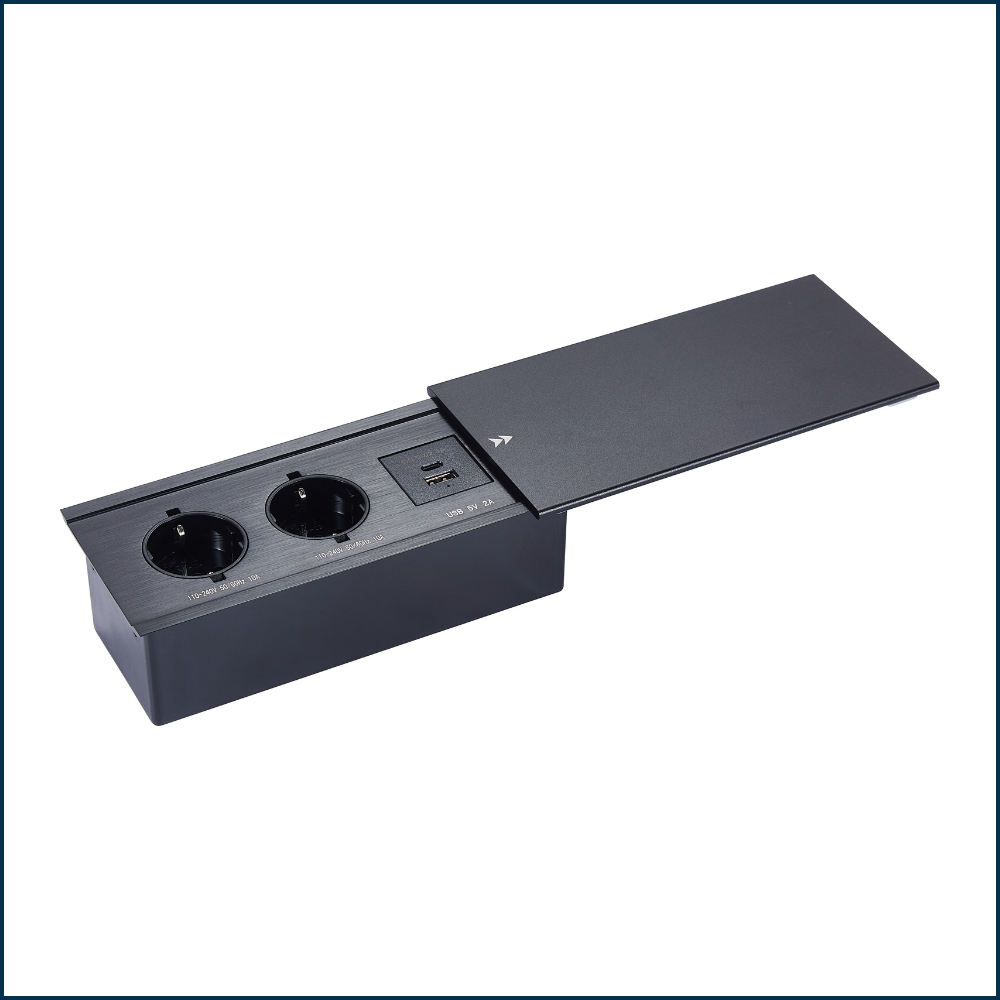
Sliding Cover Socket
A sliding cover socket sits flush in the furniture surface. To access the outlets, the user slides a cover panel horizontally — typically 60 to 80mm — to reveal the sockets beneath. The cover slides back to close.
No part of the socket rises above the surface plane. The mechanism is entirely lateral. The outlets themselves sit at or slightly below surface level, accessed from the side of the opening rather than from above.
This has two significant consequences for furniture design. First, the socket requires lateral clearance — space beside the unit for the cover to slide into. Second, the closed profile is genuinely flat: there is no raised spring mechanism, no lid that could be caught by a cloth or bumped by a passing object.
Pop-Up Desktop Socket
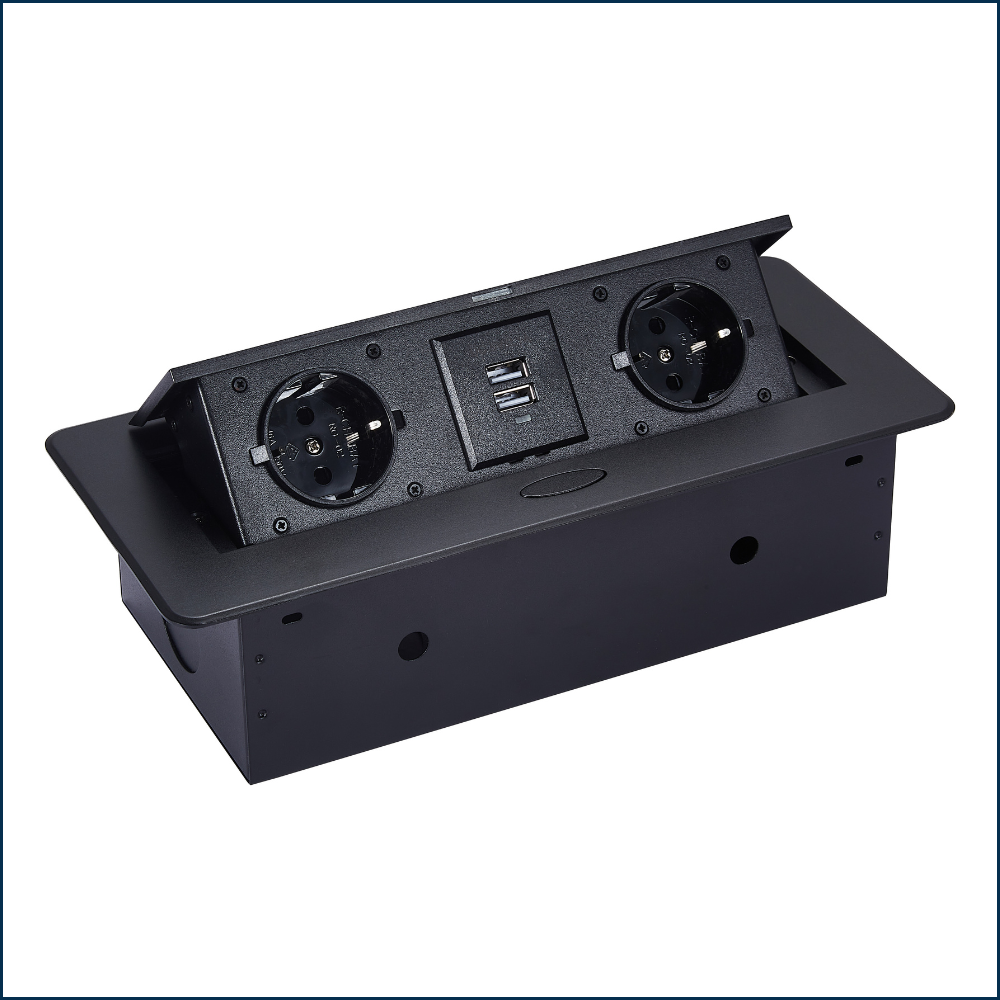
A pop-up socket uses a spring mechanism to raise the socket body vertically above the surface when activated. Press the lid, the unit rises. Press again, it retracts.
When closed, a well-made pop-up socket is flush with the surface. When open, the socket body extends 50–80mm above the surface plane, making the outlets easily accessible from any direction.
The mechanism requires vertical clearance below the surface — typically 85–90mm of clear depth — for the socket body to retract into.
Where Sliding Cover Sockets Have the Advantage
Low-Profile Furniture and Thin Worktops
The sliding cover socket’s biggest structural advantage is that it requires minimal depth below the surface. Where a pop-up socket needs 85–90mm of clear depth, a sliding cover unit can be installed in panels as thin as 20–25mm.
This makes sliding cover sockets the correct specification for:
- Low-profile coffee tables and side tables
- Thin composite stone worktops where routing depth is limited
- Furniture with internal drawer or shelf structures that prevent deep socket installation
- Kitchen islands with under-counter appliances that reduce available depth
If a pop-up socket cannot physically fit in the furniture structure, a sliding cover socket frequently can.
Surfaces Where Accidental Activation Is a Problem
A pop-up socket activated by a spring mechanism can be opened by pressure — a heavy object placed on the lid, a child leaning on the surface, a cloth dragged across during cleaning. In most applications this is a minor inconvenience. In some, it is a safety concern.
A sliding cover socket requires deliberate lateral movement to open. It cannot be activated accidentally by vertical pressure. For furniture used in environments with children, or for surfaces near cooking areas where an unexpectedly open socket could be a hazard, the sliding mechanism provides a meaningful safety advantage.
Aesthetic Continuity on Premium Surfaces
When closed, a sliding cover socket is indistinguishable from a deliberate design element — a panel joint, a material transition, a recessed line. The closed face presents as a flat rectangle rather than a circular or oval lid.
For furniture designers working with large-format surfaces — long dining tables, extended kitchen islands, conference tables — the rectangular closed profile of a sliding cover socket integrates more naturally into linear design grids than the circular footprint of a pop-up unit.
Moonian’s Sliding Cover Socket range is available in aluminium alloy panels in brushed silver, matte black, and champagne gold — the same finish options available across our pop-up range, allowing consistent hardware specification across a furniture collection.
Where Pop-Up Sockets Have the Advantage
Ease of Access
When a pop-up socket is open, the outlets are at a comfortable working height above the surface, accessible from any direction. Plugging in a kettle, a phone charger, or a laptop is intuitive.
A sliding cover socket presents the outlets at or below surface level, accessed from the side of the opening. For desk applications where a user is seated and reaching forward, this difference is noticeable. Pop-up sockets are consistently preferred in user-facing desk installations for this reason.
Standard Furniture Construction
Pop-up sockets fit into standard furniture construction without special consideration for lateral clearance. The circular cutout goes into the surface, the socket body drops below, the cable connects. No adjacent space needs to be reserved for a sliding cover mechanism.
For manufacturers producing standard desk and worktop designs where depth is not a constraint, a pop-up socket is simpler to integrate and less likely to create downstream installation problems.
Moonian’s Pop-Up Desktop Socket range is available with up to 3 AC outlets plus USB-C PD 100W in a 60mm cutout unit, CE and UKCA certified for UK and EU markets.
Head-to-Head Comparison
| Sliding Cover Socket | Pop-Up Desktop Socket | |
|---|---|---|
| Activation method | Horizontal slide | Vertical press (spring) |
| Accidental activation risk | Very low | Low–medium |
| Minimum panel thickness | 20–25mm | 35mm |
| Depth required below surface | 40–55mm | 85–90mm |
| Outlet accessibility | Side access (at surface level) | Top access (above surface) |
| Closed profile | Flat rectangle | Circular/oval flush lid |
| Lateral clearance required | Yes (cover travel) | No |
| Best for thin panels | Yes | No |
| Best for standard desk depth | Good | Excellent |
| USB-C PD 100W option | Yes | Yes |
| Aluminium panel option | Yes | Yes |
| CE + UKCA certified | Yes | Yes |
| OEM customisation | Yes, from 500 units | Yes, from 500 units |
| Cycle life (Moonian) | 30,000 cycles | 30,000–50,000 cycles |
The Specification Decision: A Practical Framework
The choice between sliding cover and pop-up sockets comes down to three questions asked in order:
Question 1: What is the available depth below the surface? If the clear depth below the cutout position is less than 85mm, a sliding cover socket is the correct specification. A pop-up socket will not fit. This eliminates one option immediately in many thin-panel and storage-heavy furniture designs.
Question 2: Who is using this surface and how? If the surface is used by children, is adjacent to cooking equipment, or is in a high-traffic environment where accidental socket activation would be a problem — sliding cover is the safer specification. If the primary user is a seated office worker who will plug in devices multiple times per day — pop-up is the more ergonomic choice.
Question 3: What is the design language of the piece? Linear, architectural furniture designs integrate sliding cover sockets more naturally. Round-edged, organic, or more casual furniture designs are better served by the circular footprint of a pop-up unit.
Pro Tip: If you are designing a furniture range that includes both worktop and low-panel variants, specify sliding cover sockets as the default. They install in both standard-depth and thin-panel applications. A pop-up socket that cannot physically fit in a thin-panel variant creates a mid-production specification change — the most expensive kind.
OEM and Custom Configuration
Both socket types are available with OEM panel finish matching, custom outlet configurations, and branded fascias on orders from 500 units per SKU.
For mixed-range furniture collections requiring visual consistency across socket types, Moonian can supply both sliding cover and pop-up units in matched panel finishes — same colour, same surface texture, same hardware family.
Full OEM process: OEM Pop-Up Socket Customisation Guide.
For furniture manufacturers considering which socket type to lead with in a new range, we recommend requesting samples of both types and installing them in a prototype piece before committing to a production specification.
Request Samples
Moonian ships sliding cover and pop-up socket samples to UK and European addresses within 15–20 working days. Comparison sample packs include one unit of each type in matching aluminium panel finish, with CE and UKCA certification documentation and installation drawings.
Contact Wenyue to request a comparison sample pack: WhatsApp: +86 15017527810 Email: wenyue@moonianhub.com
Or submit a project enquiry — we respond within 10 hours on working days.
Summary
Sliding cover sockets are the correct specification when panel depth is limited, when accidental activation is a concern, or when a linear closed profile integrates better with the furniture design. Pop-up sockets are the better choice for standard-depth desk and worktop applications where outlet accessibility from above is a priority.
Both types are available from Moonian CE and UKCA certified, with aluminium panels and USB-C PD up to 100W. For ranges that need to cover both applications, matched-finish OEM supply of both types is available from 500 units per SKU.
Specify the right mechanism for the furniture. The difference shows in the finished piece.
Moonian Technology Media Limited is a B2B manufacturer based in Guangdong, China. We supply furniture manufacturers, wholesalers, and interior fit-out contractors across Europe and the Middle East. Factory: Gaoyao District, Zhaoqing, Guangdong. Production capacity: 4,000 units/day.